September 6, 2025 | Career, Product Discovery
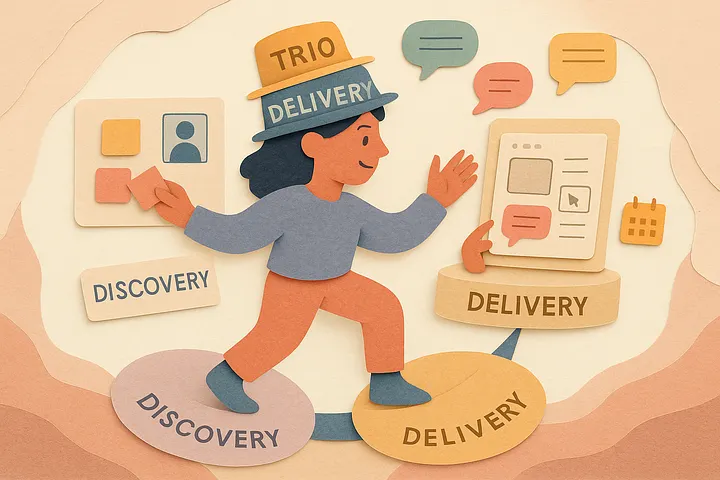
The dual role of a product designer on a trio
How design drives clarity, shapes discovery, and improves what gets built.
If design shows up late, empathy shows up last.
— Kristy Sullivan
If you want better products, you need your designer in the room, early, often, and on purpose.
The product manager might carry the discovery torch, but the designer shapes how the team understands the problem, sees the user, and explores what’s possible. And that’s just in discovery.
In delivery, designers are still:
- Polishing flows
- QA’ing visuals
- Partnering with copy
- Refining interactions
- Making sure the experience is lovable and usable
That’s the job. But it’s only half of it.
The other half? Helping the trio figure out what’s worth building in the first place.
That’s where the tension creeps in. Discovery feels like a luxury when delivery is on fire. But when designers aren’t present early, usability risks stay hidden. The solution might look great, but fall flat with real people.
This article breaks down what the dual role actually looks like: how designers stay connected to both discovery and delivery, what changes when they show up early, and why a trio without a present designer is only doing part of the work.
What it is
Being a product designer on a trio isn’t just about owning usability. It’s about showing up as a co-creator in product decisions, from the first messy customer quote to the final polished flow.
You still own the craft:
- Designing intuitive, inclusive experiences
- Prototyping concepts worth testing
- Delivering final designs that support real user success
But you also bring a product lens:
- Surfacing usability risks early
- Reframing problems before the team jumps to solutions
- Testing ideas quickly — before it costs time or trust
That dual role only works when your time and voice are protected in discovery.
If you’re constantly pulled back into polish, tickets, or bugs, the trio loses sight of how the solution feels and functions in the real world. And that’s usually where product quality starts to erode.
Your presence isn’t optional. You shape what gets built. And when the product is lovable and usable, it’s often because the designer had a seat at the table early.
How to do it
Being the product designer on a trio means you’re thinking about both delivery and discovery. You’re not just making things pretty. You’re making sure the right problem gets solved, and that the experience is something people actually want to use.
Here’s what that looks like in practice.
1. Own the usability risk.
According to SVPG’s Four Risks framework, designers own usability:
Can people use it? Does it make sense? Does it help them succeed?
This means you’re not just designing flows — you’re designing clarity.
That includes:
- Accessibility
- Consistency
- Visual hierarchy
- Interaction patterns
- Emotional cues that build trust
Usability is your lens on every idea your trio explores. Use it early.
2. Join discovery to shape, not just deliver.
Designers shouldn’t be handed specs and asked to “skin” them.
You belong in the room where the idea gets formed.
That means:
- Leading or co-leading customer interviews
- Spotting unmet needs or pain points
- Sketching fast ideas to debate with the team
- Prototyping early concepts to test with real users
- Asking: What’s missing? What’s confusing? What’s off?
You help visualize messy problems and bring them into focus. And that helps your trio make smarter, faster calls.
3. Reframe the problem.
Some of the best contributions a designer makes have nothing to do with the UI.
- You notice when the team is solving the symptom, not the root issue.
- You catch when the solution makes sense logically — but not emotionally.
- You ask the questions that shift the problem into a sharper view.
“Is this actually about setup, or is it about confidence?”
“What if the frustration isn’t the data, it’s the order of steps?”
These moments are small, but they change the direction.
4. Advocate for Feelings, Not Just Flows
When the team’s in a rush, emotional tone often gets cut. That’s when you step in.
You represent:
- Trust
- Clarity
- Empathy
- Inclusion
- The quiet moments that make an experience feel human
Sometimes that means fighting for a better empty state.
Sometimes it means pushing back on that extra click.
But your job isn’t to add delight for delight’s sake.
It’s to make sure people feel understood.
Fun Examples
The prototype that changed the problem.
The Problem
The PM thought customers needed more filter options. The tech lead agreed. The team started planning.
What the Designer Did
Instead of jumping into wireframes, the designer mocked up three simple versions of the experience, including one that removed filters entirely and focused on a better default sort.
What Happened
In interviews, customers ignored the filter-heavy screens and gravitated toward the simpler one. They didn’t want more control. They wanted less confusion.
Lesson: Don’t just design the solution. Test the problem first.
The one-liner that reframed everything.
The Problem
The trio was debating error messaging, what to say, where to say it, how detailed to be.
What the Designer Did
She paused the conversation and said, “I think the real issue is that the form is asking the wrong question.”
What Happened
They stepped back, rewrote the flow, and removed the error altogether.
Lesson: Sometimes, the most valuable design move is a question.
The flow that saved support.
The Problem
Customers were reaching out to support at a specific step in the onboarding experience. The trio couldn’t figure out why. It seemed straightforward.
What the Designer Did
The designer watched a few real user sessions and ran a short usability test.
What Happened
It turned out the language on one screen created hesitation and doubt. A small copy change and progress indicator calmed users down and support tickets dropped 30%.
Lesson: Empathy in action solves more than UX. It saves teams time and trust.
The delay that created clarity.
The Problem
The team was about to build a new calculator. Specs were written. Devs were ready.
What the Designer Did
He asked for one more cycle to prototype the end-to-end experience.
What Happened
The prototype revealed that the output made no sense without context. They added an education step before the calculator and reworked the output screen. The result felt confident, not confusing.
Lesson: Slowing down discovery can speed up delivery.
Conclusion
A strong trio builds with clarity, not guesswork. And clarity only comes when all three roles show up early, not just to execute, but to shape the work.
When product designers are active in discovery, they don’t just improve the experience. They change what gets built. They help the team see the real problem, visualize better paths forward, and make sure the solution works for the customer, not just the system.
When they’re missing, discovery gets thinner. Teams rush to build. Decisions get reactive. And the product suffers. Quietly at first. Then loudly in support tickets and churn.
So if you’re building with a trio, don’t treat design as a phase. Treat it as a voice. A partner. A co-owner of the outcome.
That’s how you move from “designed well” to “designed right.”
Take Action
1. Get design in the room early.
Check your current habits. Is the product designer part of interviews, ideation, and assumption testing? If not, make space. Don’t wait until it’s time to “mock it up.”
2. Frame design’s dual role out loud.
Remind your trio and squad that design isn’t just about polish. It’s about problem framing, usability, and emotional clarity. Make that visible in your expectations and planning.
3. Use every opportunity to visualize.
Instead of discussing ideas abstractly, sketch something. Draw a flow. Mock up a low-fi concept. Let visuals drive alignment and decisions.
4. Invite the reframe.
Before you commit to solving a problem, ask the designer to push on the framing. Are you solving the right thing? For the right person? In the right moment?
5. Show up for outcomes
Designers shouldn’t just ship files. They should own whether the experience worked. Track what you learn. Use it to influence the next cycle.