September 18, 2025 | Career, Product Discovery
Trio habits that build better products
Weekly discovery practices that keep your team sharp and your product moving.
Discovery doesn’t end once delivery begins.
That’s where most teams fall off. They treat discovery like a kickoff activity. You research, test an idea, make a few decisions, and then move on. Once something hits the backlog, learning stops.
That mindset leads to stale insights and risky launches.
Great teams keep discovery going.
They don’t wait until the next big idea or the next planning session. They talk to customers every week. They keep the opportunity space fresh. They test assumptions while delivery is in flight. They use what they learn to shape what comes next.
This is what makes a product work sustainably.
In this article, you’ll learn how to:
- Build weekly discovery habits without overwhelming your team
- Keep learning during delivery cycles
- Use customer feedback and usage data to guide your next product decision
When discovery becomes a rhythm, not a phase, the work gets clearer and more confident. That’s the goal. Let’s break it down.
What it is
Keeping the cycle going means treating discovery as a weekly habit — not a kickoff event.
Discovery isn’t something you pause for. It’s something you build into your normal rhythm.
At any given time, your product trio should be:
- Talking to at least one customer a week
- Updating the opportunity solution tree with new insights
- Running small, fast assumption tests
- Watching how the in-progress work is performing
None of this replaces delivery. It supports it.
Discovery feeds the product strategy with evidence. It helps the trio spot new opportunities, refine solutions, and avoid chasing ideas that aren’t grounded in reality.
Done well, this loop keeps the team focused on outcomes without stalling momentum.
This isn’t about doing more. It’s about doing the right work at the right time, with the customer in view the whole way through.
How to do it
Here’s how strong trios keep discovery going, even while the squad is heads down in delivery.
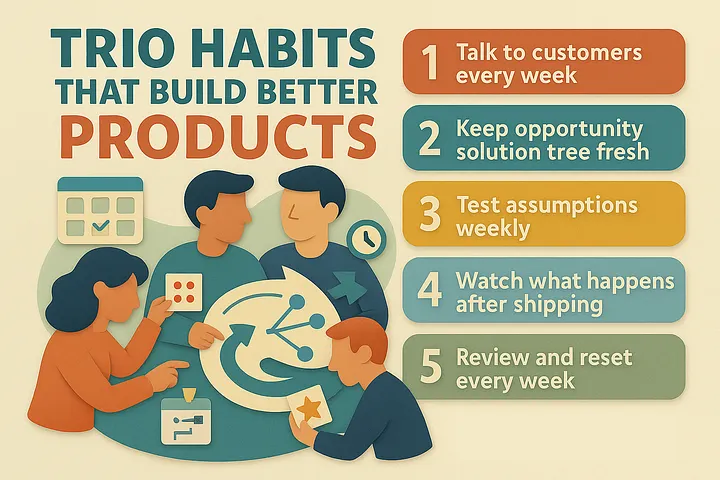
1. Talk to a customer every week.
One conversation can change what you build. That’s why weekly touchpoints matter.
- Keep it simple. Use email, a survey link, or a five-minute call.
- Rotate interviewers across the trio to build shared understanding.
- Don’t wait for perfect questions. Start with what you’re curious about.
Consistency beats complexity.
2. Keep your opportunity solution tree fresh.
If your OST never changes, you’re not learning. It’s a living, breathing representation of what you’re learning.
- After each interview or launch, revisit your tree.
- Add new opportunities. Merge or refine old ones.
- Use it during planning to align on what matters next.
This keeps the work tied to real problems.
3. Test assumptions weekly.
Ideas don’t need polish. They need proof.
- Frame assumptions behind your riskiest bets.
- Use quick tests like lo-fi prototypes, one-question surveys, or concierge flows.
- Share learnings across the team so everyone stays aligned.
Small tests build confidence fast.
4. Watch what happens after you ship.
Shipping is not the end of discovery. It’s a chance to learn in real life.
- Instrument your work so you can see behavior change.
- Use in-product prompts, surveys, or support tickets to spot issues.
- Adjust your OST based on what you learn from actual usage.
Delivery is your best feedback loop. Use it.
5. Review and reset every week.
Don’t wait for a quarterly planning cycle to think. Make it a weekly habit.
- Look at your OST. What’s moved? What’s still unclear?
- Revisit your current assumptions. What needs testing?
- Update your outcome focus. What behavior are you trying to change?
This weekly review keeps the cycle tight and intentional.
Fun Examples
The customer call that rewrote the top of the tree.
The team thought the biggest pain point was setup. Every test focused on that moment.
Then a customer said, “I already got through it. I just never came back.”
That quote changed everything. The trio added a new opportunity to the top of the OST: “Help customers return.” They paused their current test and shifted focus.
Lesson: One customer insight can change what you’re solving for.
The test that proved the risk was real.
The team had a big idea: send proactive reminders based on life events.
The assumption? Customers would opt in.
They ran a one-question prompt to test interest. Fewer than five percent said yes.
Instead of shipping the whole flow, they pivoted. The team reframed the opportunity and saved weeks of work.
Lesson: If you never test, you’ll never know.
The slice that failed and saved the next one.
The team shipped a small feature to help users track progress. It looked clean. The data was solid.
But the usage was flat.
Digging into behavior, they learned that users didn’t trust the numbers. The trio updated the opportunity in the OST and shifted to clarity and transparency.
Lesson: Shipping is how you find the real problem.
Conclusion
Discovery never stops. It’s not a phase you finish. It’s a habit you keep.
The best product teams don’t wait for a perfect moment to start discovery again. They build it into their weekly rhythm. They talk to customers, test assumptions, and update their Opportunity Solution Tree while still shipping value through delivery.
That’s how you avoid the build trap. That’s how you stay focused on outcomes. And that’s how you learn what works, not just what ships.
When discovery keeps going, your team stays sharp. Your product gets better. And each decision gets a little easier to make.
Take Action
1. Commit to weekly discovery habits.
- Talk to at least one customer every week.
- Run at least one assumption test.
- Update your Opportunity Solution Tree based on what you learn.
2. Keep your OST front and center.
- Link opportunities and assumptions to backlog items.
- Revisit the tree during planning or retro.
- Use it to explain why you’re building something — not just what you’re building.
3. Treat discovery as a trio responsibility.
- Don’t wait for handoffs. Include your tech lead and designer in every discovery step.
- Rotate responsibilities if needed, but stay aligned as a trio.
4. Integrate delivery feedback.
- Watch what customers do after you ship.
- Use in-product feedback, support data, and usage metrics to update your discovery work.
- Let live results shape your next idea.
5. Make learning visible.
- Share what you’re learning with your squad and stakeholders every week.
- Use short recaps or snapshots to keep the momentum going.