September 7, 2025 | Career, Product Discovery
The dual role of a tech lead on a product trio
Helping the trio build smarter by showing up sooner.
If the tech lead skips discovery, feasibility risks don’t disappear — they just show up later and cost more.
— Kristy Sullivan
The product only exists because engineering builds it. But the best tech leads don’t just build. They help shape what’s worth building.
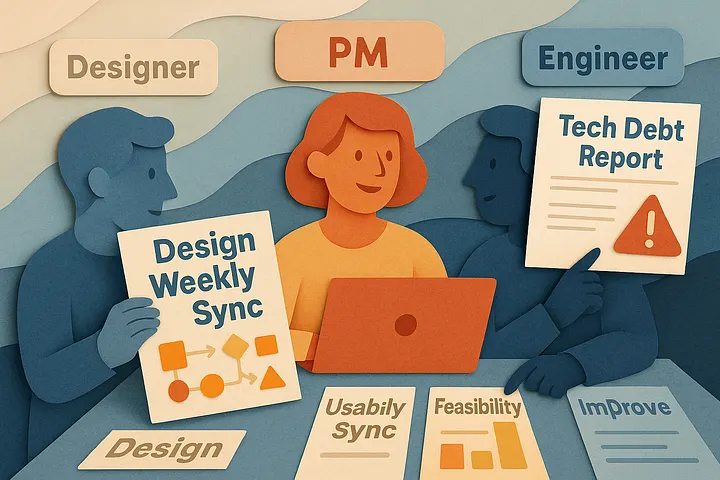
That’s what discovery needs. A real trio, product, design, and tech, working together to make smart bets. Not in handoffs. In lockstep.
But let’s be honest: tech leads are already maxed out.
- They’re leading delivery
- Unblocking the team
- Reviewing PRs
- Watching the architecture
- Keeping production stable
Discovery doesn’t always make the cut. Interviews get skipped. Feasibility risks show up late. Delivery slows down because no one caught the constraint early enough to do something about it.
That’s the cost of missing discovery.
This article is about what happens when tech leads stay close. When they make time to weigh in early, test risky assumptions, and shape the solution before it gets scoped. It doesn’t mean dropping everything. It means showing up at the right moments and being the technical voice that keeps ideas grounded, creative, and buildable.
That’s what makes a real trio work. Let’s get into it.
What it is
This isn’t about giving tech leads more to do. It’s about making their impact count at the right time.
Tech leads own feasibility. They know what’s possible, what’s hard, and what’s going to break if you push too far. But in a lot of teams, they’re brought in too late. The solution’s picked. The direction is set. And now they’re expected to “make it work.”
That’s not collaboration. That’s damage control.
A real trio brings tech into the conversation early. Not just to weigh in, but to shape the solution before the team commits.
This doesn’t mean tech leads need to join every session. It means they need to be there when it matters: during interviews, ideation, prototyping, and testing.
That’s when discovery starts to feel real. That’s when feasibility becomes a design tool, not a blocker. And that’s when the product gets better, faster.
How to do it
Let’s break it down. A tech lead’s role in discovery isn’t a bonus; it’s the difference between a plan that holds up and one that falls apart mid-cycle.
Here’s what strong tech leads do in discovery (while still leading delivery):
1. Own the feasibility risk.
In SVPG’s four-risk model, the tech lead owns feasibility:
- Can we build it?
- With the time, tools, team, and architecture we have?
This isn’t just a yes/no call. It’s about flagging real trade-offs early before the team wastes time designing something unbuildable.
2. Join discovery from the start.
That means showing up to:
- Customer interviews (or at least the debriefs)
- Ideation sessions
- Assumption mapping
- Prototyping discussions
If you’re not in the room, your input comes too late. That’s when rework starts.
3. Shape the solution, don’t just approve it.
You’re not a gatekeeper. You’re a creative constraint-setter.
The best tech leads say:
“We could do it that way, but if we reused this logic, it’d be 10x faster to build.”
“That idea’s good, but it assumes we can support real-time data. Let’s talk about what’s realistic.”
Your lens makes the idea stronger. It also keeps the team from painting themselves into a corner.
4. Use your voice early.
If you’re stretched thin, be clear about when and how you’ll engage.
- Block time for key decisions.
- Pair with another engineer to stay in sync.
- Don’t give up your seat at the table. Find a way to stay plugged in.
If you don’t show up, you’re handing off your influence. And if feasibility gets skipped, the whole team pays for it later.
Fun Examples
We thought it’d be a fast build — until the tech lead joined late.
- The trio scoped a lightweight form feature.
- The product manager and the designer ran discovery, framed the problem, and had high confidence.
- In review, the tech lead flagged an issue: the form required real-time scoring logic that didn’t exist — and wouldn’t fit in this cycle.
They had to pull the feature and rework the scope.
Lesson: A “simple” idea isn’t simple if engineering hasn’t seen it.
A tiny insight from the tech lead changed everything.
- The team had two prototypes, both solving the user problem, but both were complex.
- In a trio session, the tech lead said, “What if we use the batch scoring from the dashboard instead?”
The team tested it. It worked. The solution was cut in half and shipped that same cycle.
Lesson: The best ideas often come from engineering — not just execution, but the concept.
They skipped the tech lead. They paid for it later.
- Discovery ran without engineering involvement. The PM and designer built excitement around a new onboarding experience.
- Two weeks into delivery, the tech lead realized the design required architectural changes that touched three services.
- The roadmap got delayed. The trust took even longer to repair.
Lesson: When you cut the tech lead out of discovery, you risk the whole cycle and the team dynamic, too.
The “coolest” idea was also the riskiest. The tech lead helped redirect.
- The team had a flashy concept with a heavy backend requirement.
- During assumption mapping, the tech lead said, “We can test the same value with a static experience first.”
That test saved them weeks and validated the idea before any backend code was written.
Lesson: Feasibility isn’t just a blocker, it’s a path to faster validation.
Conclusion
The product doesn’t exist without engineering. And great product decisions don’t exist without tech leads in the room.
When tech leads only weigh in at the build phase, discovery turns into wishful thinking. Ideas sound good, look good, but fall apart the moment you check feasibility.
But when tech leads show up early, during interviews, ideation, and assumption testing, the whole team benefits. You catch risks before they cost you. You shape smarter solutions. You build trust.
Joining discovery doesn’t mean stepping away from delivery. It means shaping what’s worth building before the team spends a minute building it.
So if you’re a tech lead, your lens matters. Show up. Speak up. Ask the hard questions. You’re not slowing things down. You’re sharpening the thinking.
And if you’re a product manager or product designer: don’t wait. Pull your tech lead in when things are still messy.
The trio works best when all three roles are in it from the start. Start there.
Take Action
1. Pull your tech lead into discovery early.
- Invite them to interviews, not just readouts
- Include them in ideation and assumption mapping
- Ask for feasibility checks before testing, not after
2. Use a shared risk lens.
- PM → Value
- Designer → Usability
- Tech Lead → Feasibility
Every solution needs to pass all three.
3. Talk about the dual role.
- Acknowledge delivery pull and capacity.
- Clarify expectations with your trio.
- Don’t assume alignment. Create it.
4. Decide how you’ll handle gaps.
- If the tech lead can’t be in discovery, who will represent feasibility?
- How will you sync?
- What decisions can wait, and what can’t?
5. Make this a habit.
- Discovery works when it’s shared.
- Don’t save tech for later.
- Build with the trio, not after it.