July 28, 2025 | Career, Product Discovery
Story mapping the experience
Turn scattered insights into a clear, shared experience map.
Story mapping isn’t about drawing boxes; it’s about surfacing blind spots so the whole team sees the same picture.
— Kristy Sullivan
What is a story map?
A story map is a simple, visual way to lay out the steps a user takes to reach a goal with your product. It maps the journey as a sequence of actions, showing what people actually do, not just listing features or tasks.
The key parts of a story map:
- The user goal (for example, Book a flight)
- The steps the user takes (like Search flights, Select flight, Add passenger details, Pay)
- The tasks or details under each step (such as Enter destination, Choose dates, Apply filters)
A good story map gives your team a clear picture of how the experience works from the user’s point of view. It helps you spot friction, define success, and stay aligned on what matters most.
In short:
- Story maps show the user journey
- They align the team
- They support faster, clearer learning
Examples
Learning Journey
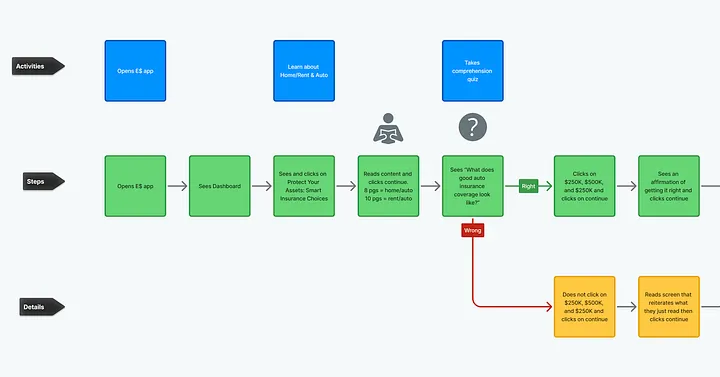
Storymap Example of a Learning Journey
Storymap Example of Getting Life Insurance
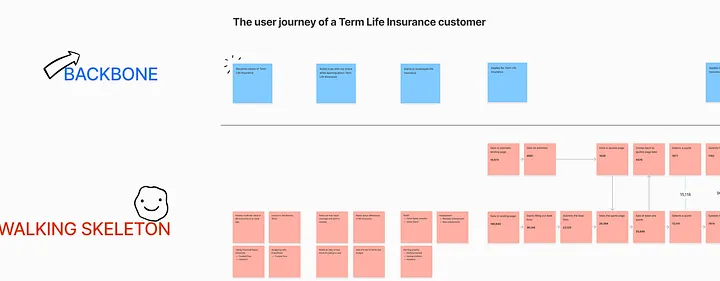
Storymap Example of Getting Life Insurance
Where does story mapping fit in continuous discovery?
If you’re practicing continuous discovery, you’re constantly learning, testing, and adjusting. A story map becomes your steady reference point, the picture you return to as you explore opportunities and evolve solutions.
Here’s how it helps:
Connect opportunities to solutions
Let’s say interviews reveal that customers keep getting stuck on payment errors. Instead of jumping to fixes, map the payment flow. It’ll show you where the breakdown happens and what’s missing from the experience.
Clarify assumptions
Maybe you’re building an “add traveler” feature because you think people want it. Story mapping forces you to pause. Does that step even show up in the real journey? Where would it go? Is anything else missing?
Align the team
When engineers, designers, and product managers can all point to the same customer steps, you cut through noise and stay focused. You’re not just talking about features, you’re solving for actual behavior.
When you’re meeting with customers weekly, the story map becomes a living artifact. You update it as you learn. You test new ideas against it. And over time, it tells the true story of your product’s progress.
Fun Examples
Story maps are flexible. Use them once to clarify thinking. Use them weekly to guide decisions. Here are a few ways I’ve seen them work well:
Sticky notes on a wall or digital board
The classic approach. Fast to create, even faster to change. The team sees the story take shape in real time and sees where their views don’t match.
As-is vs. to-be maps
Want to fix a broken flow? Start by mapping the current experience. Then map what better could look like. Comparing the two makes it easier to ask, “What’s the real gap here?”
Prioritizing by walking the map
Forget debating features in a spreadsheet. Walk through the story. If a task is crucial for the next step, it stays. If it’s not, it goes lower or gets cut. The story becomes the filter.
Live editing during research
One team kept their story map open during user interviews. Every time a customer described a workaround or skipped a step, they’d adjust the map. It kept learning front and center.
Spotting assumptions
A team I worked with mapped their onboarding flow from memory, then compared it to actual user sessions. Huge mismatch. Turns out, the first email wasn’t even being opened. The map made the disconnect visible.
Conclusion
Story mapping isn’t just a planning tool. It’s a thinking tool. It forces your team to slow down and ask, “What does the user actually do here?” not just “What do we want to build?”
That kind of clarity speeds everything up. It shifts the conversation. The team shares a mental model. Problems show up sooner. You make better calls. You stop mistaking tasks for progress.
And the best part? Story maps evolve. That’s what makes them so useful. They’re never finished, and that’s the point.
Keep it visible. Keep it active. And keep it honest.
Take Action
If you haven’t used one before, try this:
- Pick one user goal, just one.
- Map the steps it takes to reach it. Start messy.
- Ask your trio, “Does this reflect what people actually do?”
- Spot one part that’s painful or unclear. Circle it.
- Use the map in your next conversation — whether it’s prioritization, design, or research planning.
Learn more about Storymapping at NN/g or Jeff Patton User Story Mapping.