August 23, 2025 | Career, Product Discovery
Identifying risks of customer solutions
Find your riskiest assumptions before you build the wrong thing.
You can’t reduce risk if you don’t know where it lives.
— Kristy Sullivan
You’ve got a few promising ideas on the table. Now comes the part most teams skip: slowing down to spot what could go wrong.
This is where you shift from hoping something works to proving it can by identifying the assumptions hiding inside your ideas.
Assumptions are sneaky. They sit underneath your designs, roadmaps, and plans. And if you never say them out loud, you can’t assess the risk.
This article will walk through how to identify assumptions with your team, frame them clearly, and spotlight the ones worth investigating next.
What it is
dentifying risks means surfacing the assumptions your idea depends on and understanding which ones are most likely to break your solution.
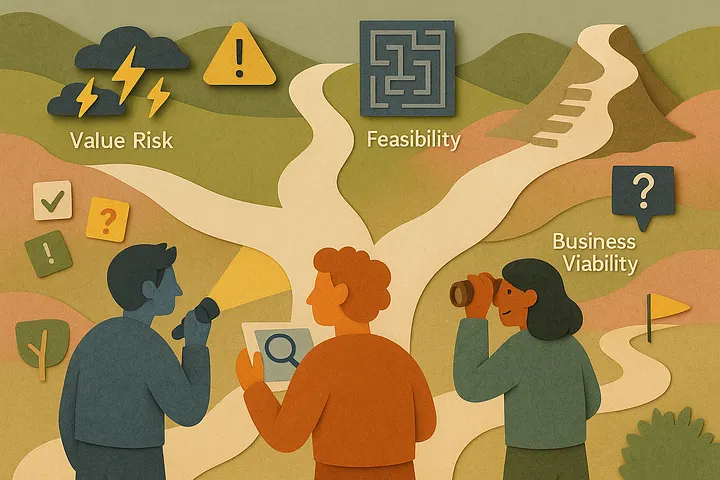
Every product idea rests on five types of assumptions:
- Desirability — Will people want it?
- Feasibility — Can we build it?
- Viability — Will it support the business?
- Usability — Can people use it?
- Ethical — Are we handling this responsibly?
When an idea fails, it usually fails because one of these was wrong.
The goal is not to test everything. It’s to find the most fragile spots in your thinking, the ones with the least evidence and the highest risk.
That’s where to focus.
How to do it
1. Align on a focused opportunity.
Before you start talking about risk, get clear on what you’re solving. Your trio should align with stakeholders on one opportunity from your Opportunity Solution Tree. Don’t spread your risk work across multiple branches.
2. Come up with three distinct solutions.
Use Supercharged Ideation or another method to generate three different ways to solve the opportunity. This step matters if you only have one idea; you don’t have a decision to make.
3. Story map each solution.
With your trio and squad:
- Build a simple story map for each solution.
- Start from awareness and walk through the steps a customer would take to receive value.
- Assign lanes (e.g., Customer, System, Support).
- Keep the map focused on the happy path.
This sets the foundation for spotting where assumptions live.
4. Identify assumptions for each step.
For each part of the story map, ask: What has to be true for this to work?
Write those assumptions out in positive language as if they’re facts you believe.
Place each assumption directly below the step it connects to. Label the type:
- Desirable
- Feasible
- Viable
- Usable
- Ethical (optional)
Your goal is to surface all the assumptions, not validate them yet.
5. Spot the riskiest assumptions.
Now shift to identifying which assumptions matter most.
Use a simple 2×2 lens:
- Importance — Would this break the idea if it’s wrong?
- Evidence — Do we have strong evidence that this is true?
Focus your attention on the assumptions that are:
- High importance
- Low evidence
These are the cracks worth investigating. You won’t act on all of them, just the riskiest few.
Fun Examples
The sticky notes were a trap.
A squad generated dozens of ideas and assumptions during a brainstorming session. It was messy and unfocused.
Then they story mapped one idea and only wrote assumptions directly under each step.
Everything snapped into place. They saw where the unknowns really were and which ones to tackle first.
The wild idea turned out less risky than expected.
One solution felt bold and risky. But after writing out the assumptions, they realized they had solid evidence for most steps.
The other idea , seen as safer, was built on three big leaps of faith. That changed how they prioritized testing.
We were making tech decisions without feasibility input.
Engineering hadn’t been part of early ideation. When they joined for story mapping, they spotted several feasibility risks no one had considered. One blocker could’ve derailed the whole solution if caught later.
Conclusion
You can’t reduce risk if you don’t know where it lives.
By identifying your assumptions early, you turn fuzzy ideas into clear bets. You give your team the power to spot weak spots before they grow into wasted effort.
Don’t fall into the trap of false confidence or fast building. Every good solution starts with a clear-eyed look at what has to be true, and the humility to admit what you don’t know yet.
Take Action
Here’s how to start identifying risks on your team:
- Pick one solution to the story map.
- Walk the experience step by step with your squad.
- Write assumptions in positive language beneath each step.
- Label assumption types using the five risk categories.
- Spot the riskiest few using the importance/evidence lens.
You don’t have to test them all , just get clear on where the risk lives.