August 23, 2025 | Career, Product Discovery
Taking a bet after testing the risks of a customer solution
When the signals are strong, the next move is a bet, not a guess.
Every product decision is a bet. You’re just better off when you know what you’re betting on.
— Kristy Sullivan
You’ve tested the riskiest assumptions. Now you’re staring at the results, wondering: Is this enough to move forward?
This is the part where teams often stall. They want perfect answers. A clear yes or no. But product work doesn’t give you that. It’s ambiguous and messy.
You’re not looking for certainty. You’re looking for enough signal to make a confident call.
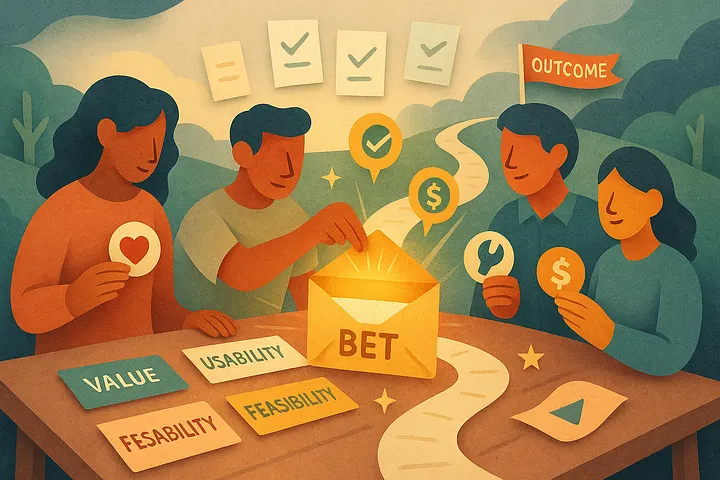
Taking a bet means making a decision — on purpose, as a trio — about where to go next. It means moving forward with eyes open, knowing what you’re committing to and why.
This article will help you:
- Make the leap from testing to building.
- Decide as a trio what’s worth trying.
- Stay aligned and focused as you commit.
- Track confidence and course-correct when needed.
What it is
A bet is a shared decision to build, test, or ship something based on what you’ve learned. It’s your next best guess that’s rooted in evidence, not assumptions.
This is the moment where discovery becomes delivery.
But here’s the difference: you’re not blindly executing a feature. You’re making a small, intentional commitment to learn more, move the outcome, or get clearer.
A good bet is:
- Tied to a validated opportunity
- Backed by tested assumptions
- Framed around clear outcomes
- Owned by the trio
- Small enough to learn from, big enough to matter
You’re not committing to a 6-month roadmap. You’re taking the next right step with purpose.
How to do it
1. Review what you learned.
Pull together your key signals:
- What did you learn from your assumption tests?
- Did customers behave the way you expected?
- What surprised you?
- Are any big risks still unresolved?
Bring your trio into one conversation to review everything in plain language, no decks, no fluff.
2. Use a confidence scale.
Talk through your collective confidence. Try something simple like:
- Hope — 10%
- Think — 30%
- Believe — 70%
- Know — 100%
Ask each person: Where are you on this scale?
You don’t need 100%. But you do want alignment around “Believe.” That’s usually enough to move forward.
If someone is stuck at “Hope” while others are at “Know,” slow down and unpack why.
3. Make the call as a trio.
Ask:
- Do we believe this idea addresses the opportunity?
- Do we believe it will move our outcome?
- Are we willing to commit team time and energy to test or build it?
You’re not trying to win a debate. You’re making a shared call to move forward or not.
If the answer is yes: write it down as a bet. Keep it clear and focused. Something like:
“We believe that adding a guided walkthrough will reduce drop-off after the results page. We’ll measure impact by tracking completions and revisit rates.”
If the answer is no: that’s progress too. Capture what broke the bet and look for a new path.
4. Set boundaries for the bet.
Even a strong bet needs guardrails.
Ask:
- How long are we committing to this?
- What signal would confirm it’s working?
- What would tell us to stop or pivot?
Write down the boundaries. Keep it small and sharp. This isn’t a roadmap item. It’s a learning loop.
5. Share the bet and why you made it.
When you take a bet, tell the story behind it. Not to justify, but to bring others along.
Share:
- The opportunity
- The signals you saw
- The risks you tested
- The decision you made
- How you’ll know it’s working
This builds confidence inside your team and trust outside of it.
Fun Examples
The multiple-choice question that got a first date.
The setup:
The team noticed a drop-off after users got their results. They had a hunch: maybe we’re overwhelming people with too many next steps.
The bet:
“We believe that showing a single, simple question — ‘What’s your top priority right now?’ — will improve engagement.”
The outcome:
Click-through jumped by 18%. Turns out, people want to be asked. The team kept it in and started using that one-question tactic in three more places.
The integration that looked cute online but ghosted us in person.
The setup:
A slick third-party API would speed up development. Everyone assumed it’d be easy.
The bet:
“We believe we can plug this in with no backend changes and minimal risk.”
The outcome:
Two hours into a feasibility spike, the team hit authentication issues and unrecoverable errors. They pulled the plug, saving weeks of frustration. Dodged a bad relationship before it started.
The trio that called a timeout instead of a tie-breaker.
The setup:
Two people were ready to go live with a copy update. The third wasn’t convinced — it felt off-brand and could backfire emotionally.
The pause:
Instead of forcing consensus, they stopped and checked their confidence scale. One person was still at “Hope.” They decided not to guess.
The outcome:
They ran another quick round of user tests and saw exactly what was missing: tone. They rewrote it, retested, and got results the whole trio believed in.
Conclusion
Taking a bet is a muscle. You build it by making small, intentional decisions, not by waiting for perfect information.
When you turn discovery into action, you’re not just collecting insights. You’re using them.
This step helps your team:
- Move from learning to building.
- Align on what matters right now.
- Track confidence as a signal, not a feeling.
- Make faster, smarter calls together.
The best bets don’t start with a roadmap. They start with evidence, a conversation, and a choice.
And once you make it, the next part is simple: go learn what happens next.
Take Action
Want to practice making better bets? Try this with your trio:
1. Review your last few assumption tests.
What did you learn? Where are you still guessing?
2. Pick one idea that feels strong.
Make sure it’s rooted in a real opportunity — and has at least one risky assumption addressed.
3. Rate your confidence.
Use Hope → Think → Believe → Know. Talk it through. Align.
4. Write the bet.
Use the format: “We believe that [idea] will [impact]. We’ll know it’s working if [signal].”
5. Set a timebox.
Decide how long you’ll test or explore this bet before reviewing again.
That’s it. You’ve made a bet. Now go learn something.