September 13, 2025 | Career, Product Discovery
Creating effective user testing questions
How to write clear, unbiased questions that get you feedback worth acting on
Good questions produce good feedback. If resources are tight and you only get one shot at testing, this is where to invest your energy.
Start with a goal.
Every user test needs one. If you’re working on a team, ask the product manager or leader what they’re trying to learn. If you’re working solo, define something measurable before you write a single question. Without a goal, you won’t know what to do with what you hear.
Once you have the goal, make sure you understand what it actually requires. A goal like “identify usability issues” tells you to look for friction — and that means you need tasks, not just opinions. Quantitative data can tell you whether something felt easy or hard. That’s useful.
Think like a first-time user.
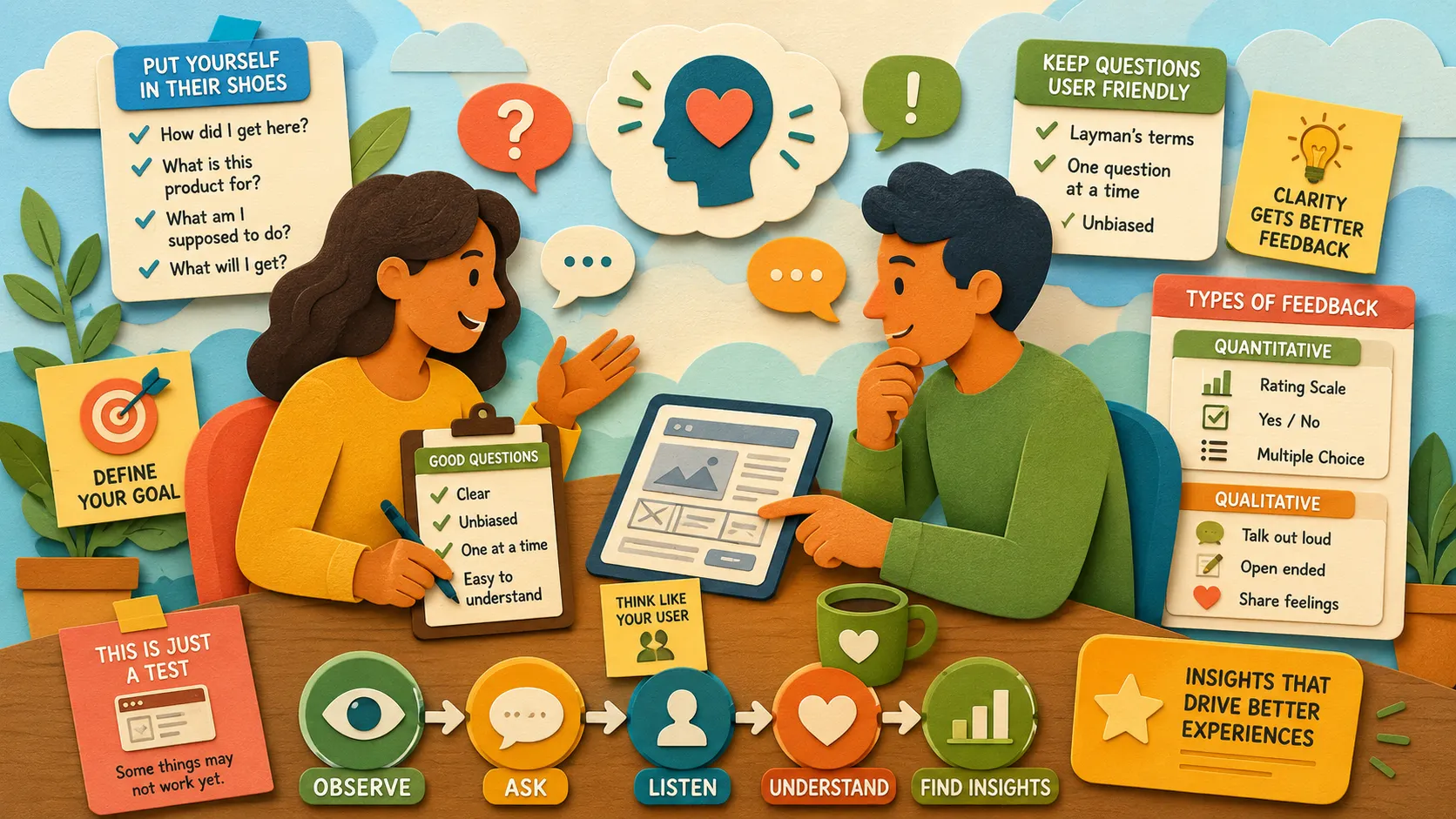
Before writing anything, put yourself in the shoes of someone who has never seen your product and takes every instruction literally. Ask yourself:
- How did I get here?
- What is this for?
- What am I supposed to do?
- What will I get out of this?
The answers to those questions shape your test introduction. Give users enough context to orient themselves before you ask them to do anything. Something like:
You were scrolling your social media feed, saw an interesting headline, and clicked through to this site.
That’s all it takes to set the scene.
Have the prototype open while you write.
Always. Looking at the actual interface keeps you from skipping over steps, and it lets you see the path you want users to take. You can’t write good tasks in the abstract.
Writing questions that work.
Use plain language.
If you’re using industry terms, rewrite the question. Users don’t know what an interstitial is. They know what a pop-up is.
One thing per question.
If a question asks about two things, you’ll get an answer about neither. Break it apart.
Write neutral questions.
“Was it hard to find the search box?” already assumes it was hard. “How easy or difficult was it to find the search bar?” gives the user room to actually tell you.
Quantitative vs. Qualitative
Both matter. You need them together.
Quantitative questions give you data you can measure: rating scales, yes/no completions, and multiple choice responses. These tell you what happened.
Qualitative questions tell you why. Ask users to think out loud. Ask open-ended questions. The most useful feedback often comes from giving someone space to describe what confused them or what they would have done differently.
A few qualitative prompts that tend to surface real insight:
- Find a class that works for your schedule. Talk out loud as you go.
- Was there anything that could have been clearer? Explain as you type.
- What frustrated you most about this site?
That last one is worth including in almost every test.
Keeping Users on Track
Tell them what isn’t functional.
If they’re testing a prototype, say so upfront. Otherwise, they’ll get stuck on broken links, and you’ll lose their attention. A simple heads-up prevents a lot of noise: Not everything in this prototype is clickable yet — that’s expected.
Reset between tasks.
If users have free rein to explore, they’ll end up somewhere you didn’t intend. Add a clear instruction before each new task: Before moving on, return to the home page.
Let them vent in writing.
Some of the best feedback comes from giving users a free-response field at the end. Writing slows people down in a useful way — they’re more deliberate, and what they type is usually more considered than what they say out loud. Ask what frustrated them, and let them go.
In Conclusion
The goal of every question is to get feedback you can actually use. Clear, grounded questions that respect the user’s perspective will do that. Vague, leading, or jargon-heavy questions won’t — and you won’t find out until you’re reviewing the results.
Write the questions. Then read them as if you’ve never seen the product. If anything gives you pause, rewrite it.