September 18, 2025 | Career
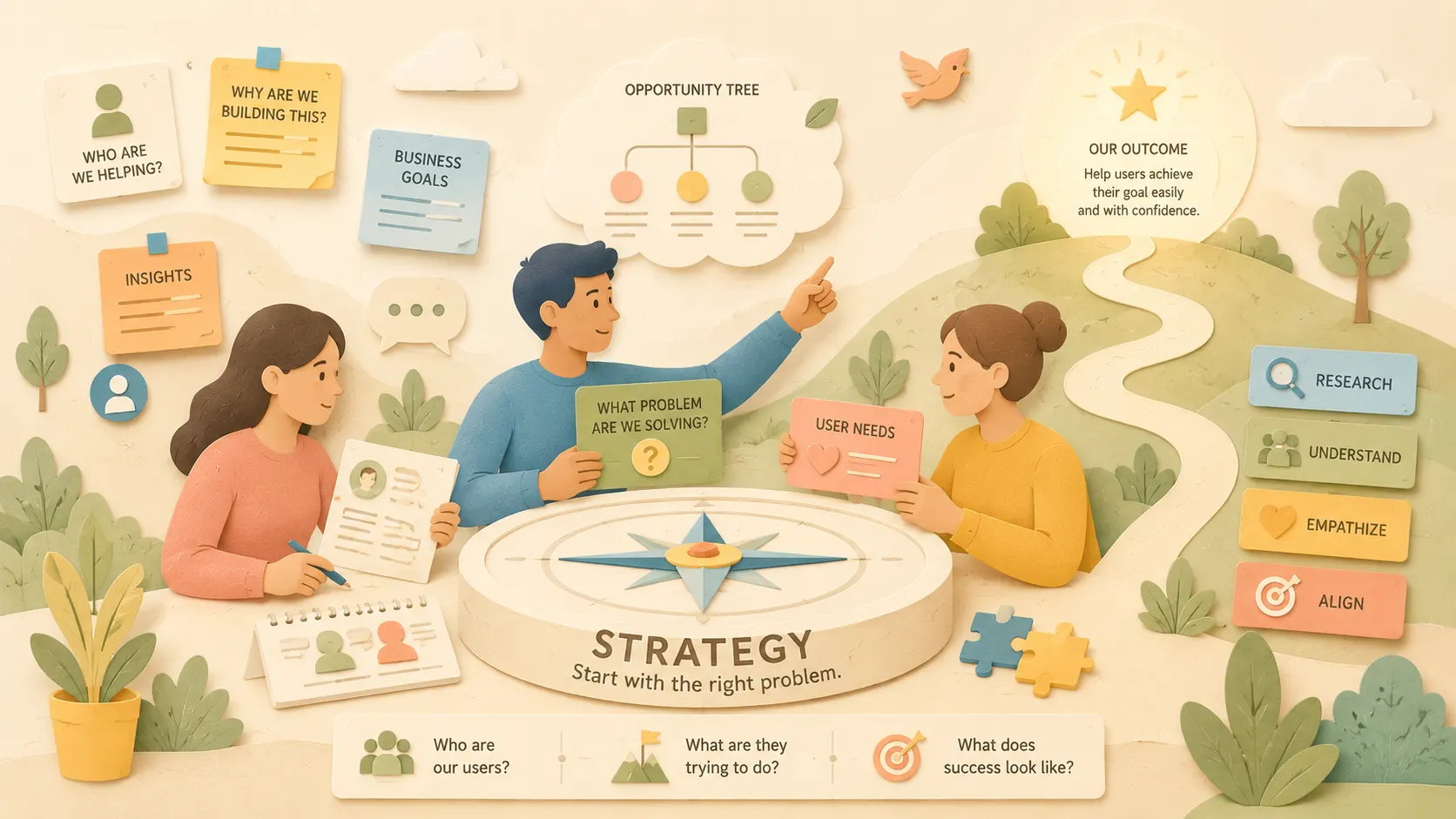
The strategy plane: start with the right problem
What good UX starts with and what teams skip when they’re in a rush.
The Strategy Plane is where I always start. New product? New feature? Hopping into a messy experience? This is the first layer I reach for.
It helps me get my head around what’s really going on, what we’re solving, who it’s for, and what success actually looks like. Without that clarity, I’ve seen teams waste weeks chasing the wrong outcome or building something no one needs.
Most teams skip this step. They start with an idea, jump into features, and call it progress. But when strategy is missing, alignment falls apart. You end up with scattered decisions, rework, and a product that looks fine but doesn’t deliver.
The foundation of a successful user experience is a clearly articulated strategy.
— Jesse James Garrett
A strong strategy gives the work direction. It pulls everything into focus. It’s how you turn loose ideas into a product that’s worth building.
In this article, I’ll break down what the Strategy Plane is, how to work in it, and the tools, skills, and habits that keep it strong.
What the strategy plane is
The strategy plane defines the foundation of the product. It gets everyone aligned on the problem you’re solving, who you’re solving it for, and what success looks like.
This is where you connect user needs to business goals. It’s not just about being user-centered or checking a box. Strategy gives the work direction. It sets the focus for everything that comes next.
In Inspired, Marty Cagan calls this the foundation of meaningful product work — when product teams deeply understand both the customer problem and the company outcome they’re driving toward.
If this layer is weak or missing, the rest of the work suffers. I’ve seen teams spin on priorities, chase the wrong metrics, or ship something that looks good but solves nothing. When strategy is clear, it’s easier to say no to distractions and yes to what matters.
The important consideration here is to not build the roof of the house before you know the shape of its foundation.
— Jesse James Garrett
This isn’t about making it perfect. It’s about getting the big questions out in the open so the team can move forward with purpose.
How to work in the strategy layer.
Working in the strategy layer means slowing down just enough to define what you’re doing and why. That doesn’t mean writing a long brief or running a weeks-long discovery sprint. It means getting clear on a few core things before jumping into solutions.
Here’s what that looks like:
1. Define your outcome.
What’s the business goal? What’s the user outcome? Strategy connects both. If you only focus on one, your product either fails to perform or fails to resonate.
Keep it simple. Write the outcome down. Make sure your team agrees. You’ll come back to this more than you think. Here are some examples.
Teresa Torres’ Opportunity Solution Tree framework is one of the best tools I’ve found for this. It forces you to define a clear outcome before jumping into solutions and helps you stay anchored in user and business value.
🚫 Vague outcome:
Improve the onboarding experience.
✅ Clear outcome:
Get 60% of new users to connect their bank account within 24 hours of sign-up.
2. Understand your users’ context.
Talk to real people. Look at real data. Strategy without user input is just guessing. You need to understand what your users are trying to do, what’s in their way, and why it matters to them.
This isn’t just about research artifacts. It’s about shared understanding across the team.
3. Frame the problem clearly.
Avoid solution-first thinking. Strategy means stepping back and asking, What’s the actual problem? Your job is to name it clearly enough that your team can rally around it and solve it well.
This is the left side of the Double Diamond in action — first diverging to understand, then converging to define. If you skip this, you risk chasing symptoms instead of solving root problems.
A good problem frame keeps you from building too much, too fast, with too little impact. Here are some examples.
🚫 Solution-first framing:
We need to redesign the homepage to boost conversions.
✅ Clear problem framing:
New visitors can’t tell what we offer or why it matters, so they drop off before exploring the product.
4. Align early and often
Strategy is a team sport. Bring in product, design, engineering, and key partners from the start. You’re not handing off a strategy doc. You’re building shared focus. Keep it alive as the work moves forward.
Artifacts, hard skills, and soft skills
Strong strategy work doesn’t happen by accident. It takes a mix of skills and artifacts that help you ground decisions and build alignment across your team and stakeholders.
These are the ones I come back to every time.
If you want a deeper dive into UX strategy work itself, Jaime Levy’s UX Strategy is a helpful resource. It focuses entirely on this layer — from defining value to validating it with users and stakeholders.
Artifacts
These don’t need to be perfect. They just need to help your team get aligned on what matters.
- Vision statement or product purpose
- Business goals and KPIs (or success metrics)
- Customer interview snapshots
- Customer journey map
- Problem framing statement
- Opportunity solution tree (starting with the outcome and opportunities)
- One-pager that connects user and business goals
Hard skills
These are the tools you’ll use to define, validate, and communicate strategy.
- User research (interviews, surveys, data analysis)
- Competitive analysis or market research
- Synthesizing insights into opportunities
- Writing and presenting product vision or briefs
- Facilitating trio or stakeholder alignment
- Mapping KPIs to user behavior
Soft skills
These are what help you navigate complexity, push for clarity, and build buy-in.
- Strategic thinking
- Curiosity and pattern recognition
- Clear communication
- Confidence to ask hard questions
- Cross-functional alignment
- Listening well and adjusting your thinking
Real-world example
Last year, I worked with a team that was spinning on a navigation restructure. They had jumped straight into layout ideas, UI feedback, and link placement. Weeks of design work, but no real traction.
The problem? They hadn’t defined the strategy clearly.
Once I stepped in, it was clear the team and stakeholders didn’t agree on the goal. Was the new nav supposed to help users find what they need faster to drive more revenue? Was it about spotlighting new products? Supporting SEO? Everyone had a different answer.
I asked to hit pause so I could get my head around it. This wasn’t a small project — millions of dollars were on the line. Our paychecks were, quite literally, at stake.
So I mapped out the five planes of UX, starting with strategy. I asked the hard questions:
- Who are our audiences?
- What are they trying to do?
- What does success look like?
From there, the work got clearer. I mapped out the rest of the planes. The team aligned on a focused message, prioritized the right content, and refined the layout based on loads of tree tests and card sorts. Each time we tested, confusion dropped. Confidence went up.
It wasn’t about making the nav look better. It was about solving the right problem for the right people.
Melissa Perri calls this out in Escaping the Build Trap: when teams don’t have a clear strategy, they get stuck delivering features instead of driving outcomes. This project could’ve easily gone that direction without a reset.
How it connects to the other planes
The strategy plane sets the foundation for everything else. If it’s shaky, the layers above will feel it.
Scope gets scattered when the strategy isn’t clear. You end up saying yes to everything because no one agreed on what matters. Structure falls apart when you don’t know what problem you’re solving. The skeleton starts to feel messy because the flows weren’t grounded in real user needs. And surface? It might look nice, but it won’t work.
When teams skip strategy, they pay for it later — in rework, in misalignment, and in missed goals.
But when the strategy is strong, the rest of the planes get easier. You have a north star. You can prioritize with confidence. You can explain your decisions. You can ship something that actually solves a problem.
In Conclusion
Strong UX starts with strategy. It’s not glamorous, but it’s where the real clarity happens.
You don’t need a perfect strategy doc or a two-week workshop. You just need to pause long enough to ask the right questions.
- Why are we building this?
- Who is it for?
- What problem are we solving?
- What does success look like?
When you skip this layer, you feel it later, in confusion, in scope creep, in work that looks good but doesn’t move the needle. When you take time to get it right, the rest of the work builds smoother and smarter.
The strategy plane isn’t extra. It’s the first step toward building something that actually matters.
Take Action
If your team is about to jump into a new feature, flow, or redesign, pause. Start with the strategy layer. Here’s how:
- Write down your product outcome. Is it clear? Is it shared across the team?
- Ask who the work is for and what they’re trying to accomplish.
- Reframe the problem before you talk about solutions.
- Use artifacts that bring clarity: a simple problem statement, a goal map, a snapshot of user needs.
- Make sure product, design, and engineering are aligned before anyone opens Figma or starts writing tickets.
This isn’t extra work. It’s the work that saves you from spinning later.
Further Reading
- Continuous Discovery Habits by Teresa Torres — A practical guide to defining outcomes and uncovering real opportunities.
- Inspired by Marty Cagan — How strong product strategy sets the foundation for everything else.
- Escaping the Build Trap by Melissa Perri — Why outcomes matter more than output, and how to shift your team’s focus.
- The Double Diamond (Design Council) — A simple model for discovering and defining the right problem.
- UX Strategy by Jaime Levy — A deep dive into UX strategy, from product vision to market validation.