September 1, 2024 | Career
The difference between UX and product designers: Why it matters now
Why the confusion between these two roles costs teams more than they realize.
The confusion around UX has been around for a long time. Over 15 years ago, the UX Designer title started gaining real traction. Now the industry talks primarily about Product Design. Titles have shifted, skill expectations have evolved, and a lot of people — hiring managers, job seekers, and team leads — are working from different definitions without realizing it.
That gap has consequences.
Why the definitions matter.
This isn’t a semantic argument. Clear role definitions affect real decisions.
Hiring — companies that can’t articulate the difference between these roles end up hiring for the wrong one. That misalignment shows up quickly and costs time and money to undo.
Job seekers — if you don’t understand how these roles differ, you can’t position your resume or portfolio accurately. You’ll apply to roles that don’t fit, or undersell yourself for ones that do.
Team clarity — within a team, ambiguity about who owns what creates gaps and overlap. Both are expensive.
Future role design — as the industry continues to change, the organizations that have clear definitions will be better positioned to shape new roles that meet actual needs.
What UX design actually is.
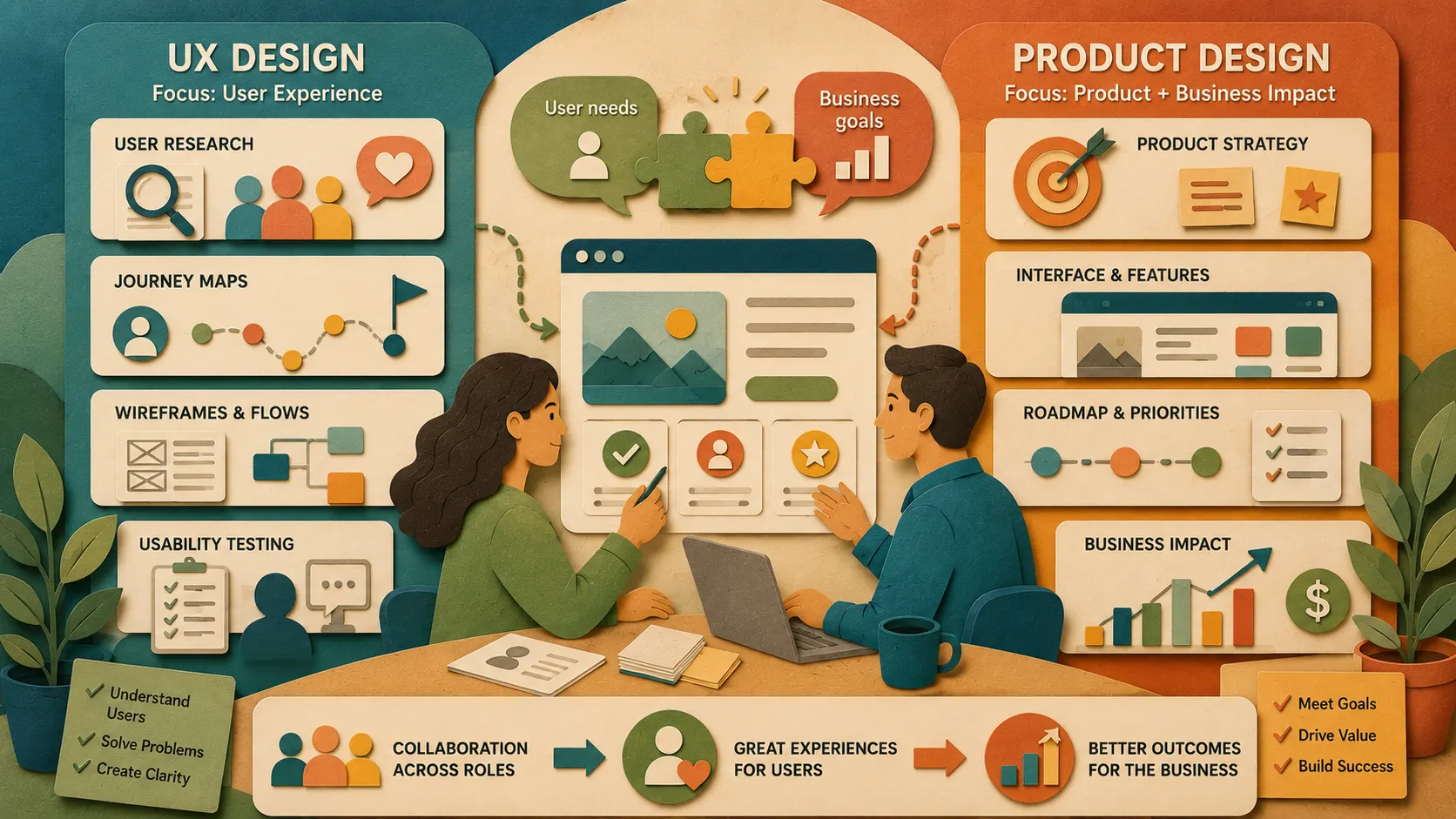
UX Design is focused on the user experience. That sounds obvious, but it’s worth saying plainly: a UX Designer’s primary concern is whether a product is easy to use, efficient, and satisfying for the people interacting with it.
The scope is broad. UX Design applies across contexts — websites, apps, physical products, service touchpoints. The through-line is always the same: does the end user have a smooth, intuitive experience?
The skill set reflects that breadth. UX Designers need to understand user research, interaction design, information architecture, and usability testing. They also need to be genuinely empathetic, strong communicators, and practiced problem-solvers. The hard skills and the soft skills are both load-bearing.
Core responsibilities typically include:
- Conducting user research and usability testing
- Creating wireframes, prototypes, and user flows
- Ensuring designs are user-centered and address specific problems
- Collaborating with UI designers and developers to implement the work
What Product Design actually is
Product Design has a broader mandate. Where UX Design centers the user experience, Product Design encompasses the entire product development process — from initial concept through launch and beyond. The goal is to create something that meets user needs and aligns with the company’s business objectives. Both things, not just one.
Product Designers still need many of the same skills as UX Designers. Understanding user needs and testing for usability are table stakes. But the role also demands strength in visual design, prototyping, and business strategy. Product Designers need to understand how a product gets built and how it fits into the market.
Core responsibilities typically include:
- Overseeing the design and development of the product
- Balancing user needs against business goals
- Working across cross-functional teams — product managers, engineers, marketers
- Contributing to UX, UI, and sometimes branding and strategy
Why you need both.
A common mistake is treating these roles as interchangeable or assuming one makes the other redundant. That’s wrong, and organizations that operate that way end up with products that are either user-friendly but strategically adrift, or business-aligned but hard to use.
UX Designers serve as the bridge between users and the product. They focus on research, usability, and the overall experience. They often work closely with marketing to make sure the experience aligns with how the brand shows up in the world — creating consistency that users feel even if they can’t articulate it.
Product Designers operate closer to the product team. They work alongside engineers, product managers, and stakeholders to turn user needs and business objectives into actual features and interfaces. They need to understand both the product’s functionality and the market it exists in.
When both roles are present and working in tandem, the product gets the benefit of both orientations. The experience is user-centered and strategically sound. That combination produces better outcomes than either role can deliver alone.
In Conclusion
The industry has changed, and the titles have changed with it. But the underlying distinction between these two roles is real and worth understanding clearly — whether you’re building a team, looking for a job, or trying to figure out where you fit in a rapidly evolving field.
Know what each role is actually designed to do. Hire accordingly. Structure your team around the distinction. The results will reflect it.