June 28, 2025 | Career
Build your design skills: How to spot trustworthy sources
A simple checklist for filtering the noise and learning from sources worth your time.
Learning about product, UX, and design has never been more accessible. That’s mostly a good thing. It also means there’s more noise to filter than ever before.
As a design leader, I actively encourage my team to keep growing their craft. But I’ve noticed a pattern: some of what’s circulating out there conflicts with principles that have held up for decades. New ideas are worth exploring — curiosity and innovation move the field forward. The question is whether those new ideas are built on proven foundations or just well-packaged opinions.
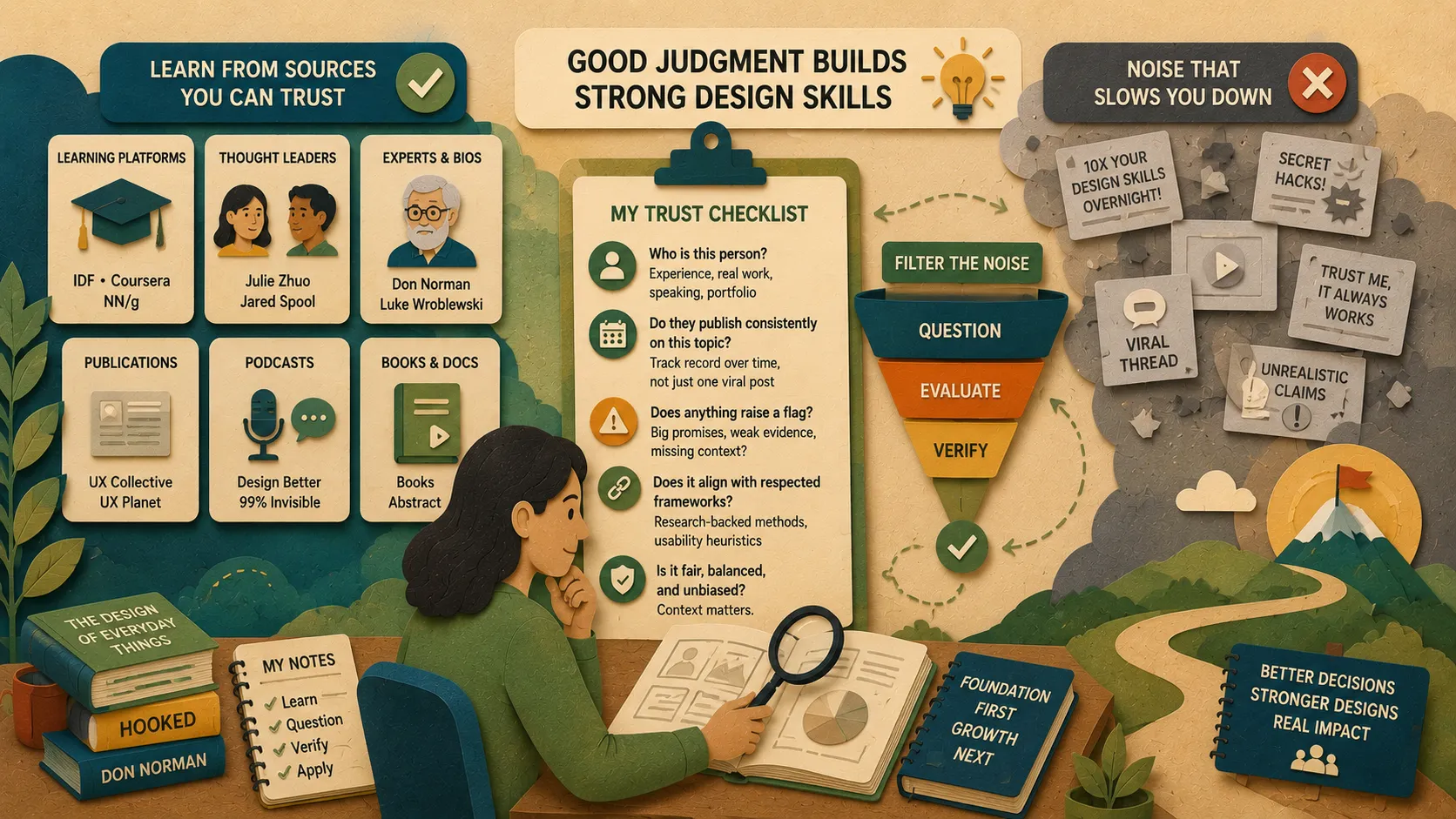
Over time, I developed a simple checklist to help assess whether a source is worth learning from. Here’s how I use it.
Where designers typically look to grow
The common places people turn to when building their skills:
- Learning platforms — Interaction Design Foundation, Coursera, Nielsen Norman Group
- LinkedIn — thought leaders like Julie Zhuo and Jared Spool
- Expert bios and personal sites — Don Norman, Luke Wroblewski
- Publications — UX Collective and UX Planet on Medium
- Podcasts — Design Better, 99% Invisible
- Books — The Design of Everyday Things, Hooked
- Documentaries — Abstract: The Art of Design on Netflix
All of these can be genuinely useful. None of them are automatically trustworthy. The platform doesn’t determine the quality of what’s on it — your judgment does.
What credibility actually looks like
Before applying any tactical filters, it helps to know what you’re looking for. A credible source typically:
- Is written by someone with real, relevant experience
- Addresses the topic fairly rather than advocacy dressed as expertise
- Uses evidence, not just assertion
- Avoids significant bias or conflicts of interest
- Aligns with established research and known frameworks
When you build on sources that meet these criteria, you grow faster and with more confidence. A strong foundation in proven ideas makes it easier to explore new ones without losing your footing.
The filters I actually use
Who is this person?
Search their LinkedIn profile. Look at job titles, years of experience, and the projects they’ve been part of. Check their website for a portfolio or case studies — real work, not just opinions about work. Look for speaking engagements or conference appearances. Someone regularly invited to present in their field has usually earned that credibility through something demonstrable.
Do they publish consistently on this topic?
Review their posting history on LinkedIn or Medium. See if they contribute to industry blogs or journals. Look for consistent publication over time rather than a single viral post. One well-performing piece doesn’t make someone an authority. A sustained body of work on a focused area usually does.
Does anything in the argument raise a flag?
Pause if someone makes big promises without showing examples. Watch for clickbait framing or exaggerated claims. Compare their recommendations against known best practices — do they hold up? Look for missing context or weak evidence. If the logic requires you to just trust them without showing their work, that’s worth noting.
Does the content align with respected frameworks?
Scan for references to research-backed methods. Check whether they cite usability heuristics or established standards. Confirm the ideas support human-centered design rather than contradict it. Ask yourself whether this content would hold up to an honest critique from someone you respect in the field.
In Conclusion
A few minutes of this gut check won’t make every learning decision obvious. But it will save you from building your skills on a foundation that doesn’t hold — and that’s the kind of thing that’s hard to undo once it’s in place.
The best designers I know are both curious and discerning. They explore widely and vet carefully. That combination is what separates someone who collects ideas from someone who builds real expertise.