November 16, 2023 | Career
Can we please stop saying UX everywhere?
The case for retiring a label we’ve outgrown.
A quick history, for context.
The concept didn’t appear out of nowhere:
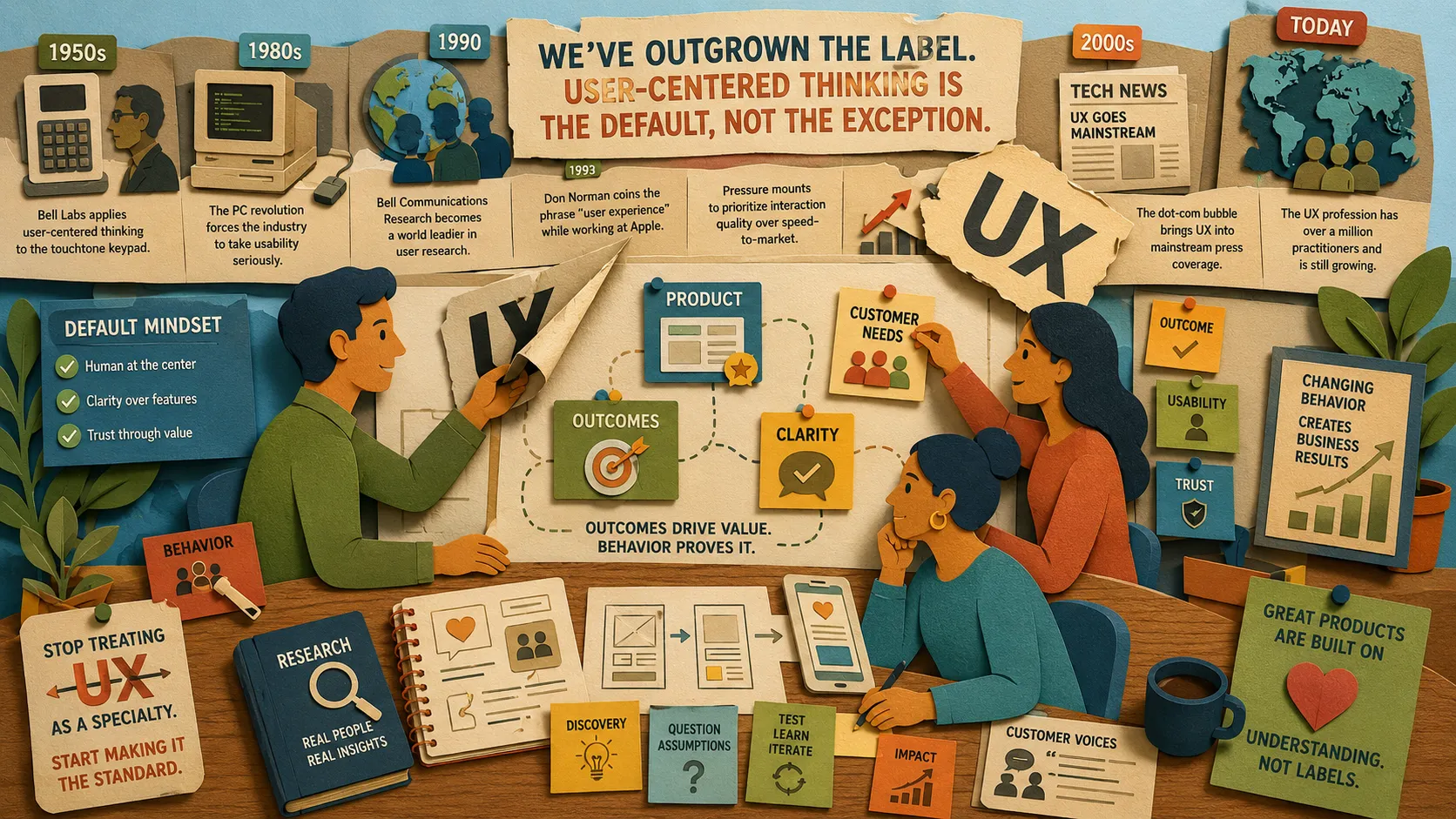
- 1950s — Bell Labs applies user-centered thinking to the touchtone keypad.
- 1980s — The PC revolution forces the industry to take usability seriously.
- 1990 — Bell Communications Research becomes a world leader in user research.
- 1993 — Don Norman coined the phrase “user experience” while working at Apple.
- 1990s–today — Pressure mounts to prioritize interaction quality over speed-to-market.
- 2000s — The dot-com bubble brings UX into mainstream press coverage.
- Today — The UX profession sits at over a million practitioners and is still growing.
So the field has real roots. The work matters. That’s not the argument.
The argument is this: why are we still using “UX” as a descriptor?
Let’s think a little deeper now.
At this point, a significant portion of people involved in building and marketing digital products have at least a foundational understanding of UX principles, UX laws, and the heuristics that guide good design. The basics aren’t a niche specialty anymore. They’re table stakes.
So when we keep tagging “UX” onto job titles, documents, and deliverables, what are we actually communicating? That this particular thing was designed with users in mind — as opposed to everything else we build?
That framing is the problem.
User-centered thinking shouldn’t be a modifier. It should be the default assumption behind every product decision, every design choice, every line of copy. If we have to call something out as “UX,” we’re implying that the work without that label isn’t held to the same standard.
We should be past that.
As technology accelerates, the stakes for getting this right go up. The products we build will shape how people interact with systems that are growing more complex by the year. Keeping the human at the center of that isn’t a specialty — it’s the job. All of it.
Stop using “UX” as a qualifier. Start treating user-centered thinking as the baseline expectation it should be.