September 7, 2025 | Career, Product Delivery, Product Discovery
Discovery and delivery belong in the same room
How trios build momentum by thin-slicing solutions and testing live behavior.
Discovery isn’t done when you ship. Delivery is where the truth shows up.
— Kristy Sullivan
Discovery and delivery aren’t supposed to live in separate worlds.
But most teams treat them like different planets: one side interviews customers and runs tests, while the other side ships whatever made it out alive. You either hear, “We don’t have time for discovery, we’re behind on delivery,” or “We can’t deliver, yet we’re still validating ideas.”
It’s a trap. And it slows everything down.
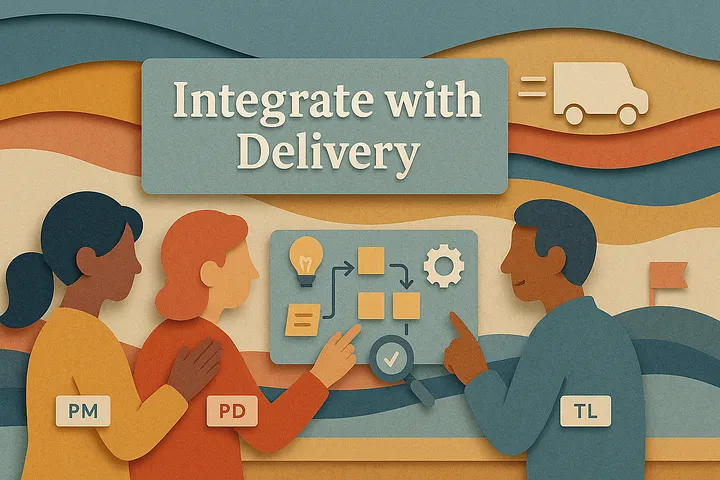
The best product teams don’t treat discovery and delivery as phases. They treat them as partners. The product trio doesn’t vanish once something moves into build. They stay close, bringing engineers into discovery, shaping thin slices with the squad, and watching how real customers respond once it ships.
Because here’s the shift: delivery isn’t just execution. It’s how we keep learning.
This article will walk through what that actually looks like in practice:
- How to bring engineers into discovery conversations
- How to slice solutions into real, testable pieces
- How to ship incrementally without losing quality
- How to measure, learn, and adjust
This is where strong product habits turn into outcomes. And where discovery work actually pays off.
What it is
Integrating discovery with delivery means your product trio doesn’t disappear when something moves into build. They stay involved — shaping what gets built, how it’s sliced, and what happens after it ships.
This is not a phase shift. It’s a rhythm.
While the squad is working on today’s release, the trio is preparing the next bet, continuing interviews, testing assumptions, and refining opportunities. They’re a sprint or two ahead, not months ahead. And they don’t throw work over the wall.
At the same time, the trio is still watching what’s in-flight. They’re present in delivery ceremonies, reviewing progress, and looking for what new learning is coming from customers. When a slice ships, they’re ready to measure it. If it works, they keep going. If it doesn’t, they adjust.
This kind of integration keeps momentum without sacrificing outcomes.
- The trio discovers, decides, and stays close to delivery.
- The squad builds in small, frequent releases.
- The whole team learns faster.
It’s how you avoid the “build trap” and create real traction.
How to do it
Here’s how strong trios integrate discovery with delivery without losing momentum or the customer.
1. Bring engineers into discovery.
Discovery isn’t just for the trio. When engineers join customer interviews, ideation sessions, and assumption testing, they build shared understanding before any code is written. They spot feasibility risks early and bring creative trade-offs to the table.
Ways to involve engineers:
- Invite them to 1–2 interviews per cycle.
- Run lightweight ideation or mapping sessions with the full squad.
- Share discovery snapshots or OST updates in standups.
2. Slice solutions thin enough to ship fast.
Trio-tested solutions don’t go straight into a 4-week build. They get sliced.
Your goal is to find the smallest version of the idea that delivers value — and gives you a chance to learn. That might be:
- A simpler entry point.
- Fewer features at launch.
- One specific use case, instead of the full journey.
It’s better to launch a slice and learn than to sit on something “complete” for weeks.
3. Ship and measure in small cycles.
Delivery isn’t done when the feature ships. It’s just the next feedback loop.
Good discovery teams use delivery to learn:
- Are people using it?
- Are behaviors changing?
- Do outcomes improve?
This means your trio needs to stay close by reviewing product metrics, watching customer behavior, and adjusting the OST when something works (or doesn’t).
4. Keep your OST visible during delivery.
When the opportunity-solution tree is front and center, the whole squad remembers why each item matters. You’re not just building features — you’re solving problems. And you’ve got the evidence to prove it.
Ways to keep it visible:
- Link relevant branches to backlog items.
- Review the OST during planning or retro.
- Show how a shipped slice ties to an opportunity.
Fun Examples
The usability test that changed our launch plan.
We had a trio-tested solution. The design looked solid. But after shipping the first thin slice, we added a one-question survey.
Turns out, customers weren’t confused by the layout. They didn’t even know the feature existed.
We paused the next sprint, focused on visibility improvements, and watched usage triple.
Lesson: Shipping is not the end of discovery. It’s the start of your next learning loop.
The engineer who spotted a smarter slice.
The original plan was a 6-week build. It tackled everything from setup to follow-up in one shot.
An engineer asked, “What if we shipped just the setup piece first?” It gave users a way to start, and let the team test whether they even needed the follow-up step.
That version shipped in 10 days.
Lesson: Engineers in discovery make ideas leaner — and better.
The backlog that got a reality check.
Half the squad thought their backlog was golden. It was full of polished stories and lined up for two cycles.
The trio stepped back and asked: “Which problem is this solving?”
Only two tickets are mapped to a real opportunity on the OST. The rest were cleanup, nice-to-haves, or vague improvements.
They reset the board and started fresh with discovery evidence leading the way.
Lesson: Your backlog is only as strong as your understanding of the problem.
Conclusion
Discovery and delivery are not two separate teams or phases. They’re part of the same product loop.
When the product trio and squad work together, you’re not just shipping faster. You’re learning faster. You’re testing assumptions, slicing solutions, and measuring results in real time.
It’s not always clean. Some cycles will feel discovery-heavy. Others will lean into delivery. But when everyone knows the problem you’re solving and how today’s work connects to that goal, you start to see real momentum.
The work gets simpler. The decisions get clearer. And the whole team starts thinking like a product team, not a feature factory.
Take Action
1. Bring engineers into discovery conversations.
- Invite engineers to interviews, ideation, and assumption mapping.
- Rotate representation if needed, but keep engineering connected to decisions early.
2. Break solutions into thin slices.
- Avoid shipping full features all at once.
- Slice by learning or behavior, not by screens or sections.
3. Make delivery incremental.
- Ship small pieces often.
- Validate usability, performance, and behavior as you go — not all at once.
4. Stay aligned during delivery.
- Keep the trio engaged during standups, retros, and backlog reviews.
- Use the OST to help the squad see how each delivery task ties to an opportunity.
5. Measure real behavior.
- Don’t stop testing when you ship.
- Use usage metrics, in-product surveys, and support data to learn what’s working — and what’s not.