August 3, 2025 | Career, Product Discovery
Mapping customer opportunities
Build alignment by showing how opportunities connect to outcomes.
If your opportunity solution tree is messy, good. It means you’re capturing the messy truth of real customer lives.
— Kristy Sullivan
Sometimes our teams jump straight into solutions before we’re even sure we’re solving the right problem. Other times, we surface a real customer need but never slow down long enough to unpack what’s behind it. We label things as problems, pain points, or jobs to be done, but the truth is, not all of them are worth our time.
That’s where opportunity mapping comes in.
In continuous discovery, we don’t treat customer feedback or user research as a list of things to fix or build. We treat it as raw material for learning. When we map our opportunity space, we’re not organizing user quotes or creating a tidy chart. We’re making a call about which customer behaviors, needs, or desires are important enough to solve and which ones aren’t.
Done well, an Opportunity Solution Tree (OST) helps us connect the dots between our business goals and our customers’ world. It pushes us to slow down, think critically, and test our assumptions before we ship a single feature. And most importantly, it helps us say no to ideas that don’t actually matter.
This article will show you how.
We’ll walk through the mindset, method, and muscle behind good opportunity mapping, and give you some practical ways to bring this habit into your product trio’s weekly rhythm.
What it is
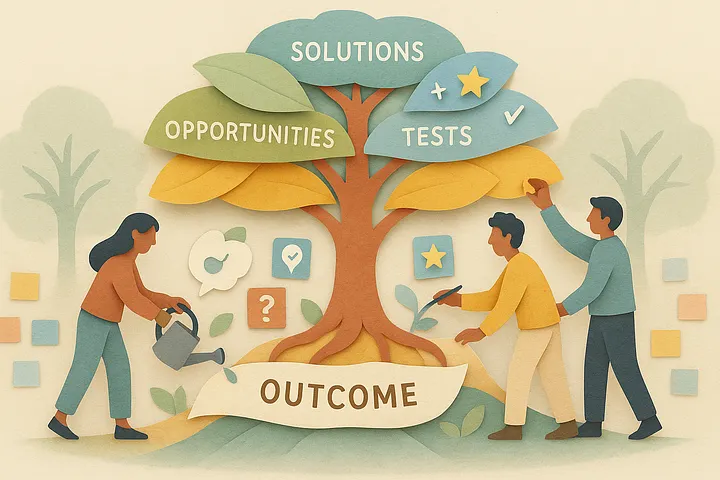
An Opportunity Solution Tree (OST) is a visual thinking tool created by Teresa Torres to help product trios stay focused on outcomes while navigating discovery. At its simplest, it maps out four (4) layers:
- Outcome: the measurable behavior change you’re trying to drive
- Opportunities: customer needs, pain points, or desires that, if solved, move you toward that outcome
- Solutions: ideas you could build to address those opportunities
- Experiments: the tests you’ll run to learn whether your solutions are actually good
That’s the structure. But the value comes from how you use it.
Unlike a backlog or a roadmap, the OST isn’t a list of tasks or deadlines. It’s a thinking tool. It forces your trio to pause and ask hard questions:
- Are we solving a real problem?
- Do we understand the underlying need?
- Are we chasing ideas, or choosing purposefully?
- Are we guessing, or learning?
Opportunity mapping is a habit of the most effective product teams. It turns scattered customer notes into insight. It turns endless ideation into focused exploration. And it turns your outcome into a north star, not just a slide in a quarterly deck.
How to do it
Mapping opportunities starts with a shift in how you think. You’re not just building features. You’re deciding which customer struggles are worth solving and why.
Here’s how I walk through an Opportunity Solution Tree with a product trio.
Step 1: Define the business outcome (root of the tree).
Start here. What does the business need right now?
This is your anchor, the thing the company cares about most in this moment. It should be measurable, time-bound, and clearly tied to how the business grows or sustains itself.
Not fluffy. Not vague. Not “make onboarding better.”
It’s:
- Grow annual recurring revenue by 30%
- Decrease churn by 20%
- Increase average customer lifetime value by 15%
- Reduce support costs by $500K per quarter
Ask your trio:
- Why is this business goal important now?
- What risk or opportunity are we trying to respond to?
- How will we know if we’re actually moving the needle?
Quick tip: If your business outcome is squishy or too general, your whole tree will wobble. Keep it tight, and keep it specific.
Step 2: Define the product outcome (first branch layer)
Once you’ve got the business outcome, zoom in closer. What can your team impact?
This is your product outcome. It’s the behavior in your product that most predicts movement in that business result. Think of it like a leading indicator.
This is the layer that connects strategy to reality. It shows what success looks like inside your product.
Examples:
- Increase trial-to-paid conversion from 15% to 25% (tied to ARR)
- Reduce onboarding time from 10 days to 5 (tied to churn)
- Increase average cart size from 1.8 to 2.5 items (tied to LTV)
Ask your trio:
- What behavior shift in the product would signal real progress?
- Can we actually measure it?
- Is this something we can move, or are we pretending?
Reminder: If your team can’t influence it, it’s not a product outcome. Be honest with yourselves.
Step 3: Map the opportunities (second branch layer)
This is where discovery gets real.
You’ve got a product outcome. Now ask: What’s getting in the customer’s way? What are they trying to do, but can’t? What’s frustrating? What’s missing?
You’re not guessing. You’re gathering real-world evidence from interviews, usability studies, support logs, and behavioral data. This is your raw material.
A good opportunity is:
- Rooted in what customers actually said or did
- Described in their words, not your solution language
- A problem, pain, or desire — not a feature
- Directly tied to your product outcome
Use parent-child relationships to break things down.
Opportunities usually nest. The big struggles break down into smaller ones. That’s good. That’s what you want.
Here’s what that can look like:
Parent: People give up halfway through the budgeting setup.
- Child: They’re confused about which expenses to include.
- Child: They don’t want to guess what’s ‘normal’ to budget.
- Child: They panic when their categories don’t add up to their income.
Parent: Customers don’t click ‘Schedule a Call’ with the insurance pro.
- Child: They don’t know what to expect from the conversation.
- Child: They assume it’ll be a sales pitch.
- Child: They don’t want to share their phone number with a stranger.
Parent: Couples struggle to track shared financial goals.
- Child: They each have their own login, but nothing feels joined.
- Child: They argue about who moved money where.
- Child: They want to celebrate progress together, but don’t see it visually.
You get the idea. Parent opportunities are the bigger themes. Child opportunities are the specific friction points under the surface. If you can name the child clearly, you’re close to something testable.
But you can’t make this stuff up. It needs to come from real customer input, what they say, what they do, and where they stumble.
Where to find opportunities:
- Weekly interviews (ask open-ended questions and listen hard)
- Watching users fumble during usability tests
- Patterns from support tickets, NPS comments, or product reviews
- Usage analytics that show drop-off points or dead ends
Ask your trio:
- What’s the real struggle here?
- Are we capturing what they said, or what we assume?
- Which of these needs are connected to the behavior we’re trying to change?
Fun Examples
Opportunity mapping isn’t just for big product strategy sessions. The best teams use it in the small moments, like when they’re stuck, when they’re flooded with ideas, or when they realize their roadmap feels like a random pile of features.
Here are a few ways I’ve seen product trios bring it to life:
We have too many ideas.
The situation:
A team had 30+ features scattered across a FigJam board. Everyone had a pet idea. No one could agree on what to build next.
What they did:
They stopped debating features and re-centered on their product outcome. Then they mapped opportunities based on real customer needs, and only attached ideas once they had clarity.
The result:
Five ideas stayed. Twenty-five dropped off. The team felt aligned, not defeated.
We don’t know what to build.
The situation:
A trio was told to “increase activation,” but the behavior drivers weren’t clear. They didn’t want to build blind.
What they did:
They spent three weeks interviewing new users and logged quotes as customer struggles. Once they mapped the opportunity space, one theme stood out: emotional friction — people felt judged by their budget.
The result:
They rewrote the copy and redesigned the first screen to reduce shame. Activation jumped 12% in two sprints.
Cross-team confusion slows us down.
The situation:
Two squads were stepping on each other’s toes. Product leaders were trying to draw boundaries, but it wasn’t clear who owned what.
What they did:
Designers from both squads mapped their OSTs on a whiteboard together. Within 45 minutes, they realized they weren’t even solving the same problem.
The result:
They aligned around one shared outcome, split responsibilities by opportunity area, and moved forward without needing a turf war.
Conclusion
Most teams don’t struggle because they’re lazy or unskilled. They struggle because they’re moving fast without a clear map.
An Opportunity Solution Tree gives your trio a way to slow down just enough to think. It keeps you focused on outcomes, rooted in real customer needs, and honest about what’s worth building. It also gives you language to say no, not because an idea is bad, but because it doesn’t solve a meaningful problem.
When you make opportunity mapping a regular habit, you stop chasing shiny features and start making sharper bets. Your discovery gets faster. Your experiments get clearer. And your whole team builds with more confidence.
This isn’t about adding a new process. It’s about improving your judgment together.
You’ll be surprised how fast things come into focus once you make your thinking visible. The best product teams don’t just talk about being customer-led. They build maps to prove it.
Take Action
You don’t need a fancy tool or a two-hour workshop to start mapping your opportunity space. Just start.
Here’s how to put this into practice with your trio this week:
Clarify your product outcome.
Write it down. Make sure it’s measurable, behavioral, and actually in your team’s control. If you can’t move it, pick something else.
Review recent customer input.
Look at your latest interviews, usability sessions, support logs — where are people struggling? What are they trying to do?
Write down real opportunities.
Use sticky notes or a shared doc. Keep each note framed in the customer’s words. No solutions. No business speak.
Group and connect them.
Are some struggles related? Does one create another? Start sketching your parent-child relationships. This doesn’t have to be perfect — it just has to be honest.
Look at what’s missing.
Where do you need more input? Plan your next interviews or tests based on the gaps in your opportunity space.
Update it weekly.
Block 15 minutes with your trio. Review what you’ve learned. Add new evidence. Adjust the tree. This is a living artifact — not a one-and-done deliverable.