May 4, 2023 | Career, Product Discovery
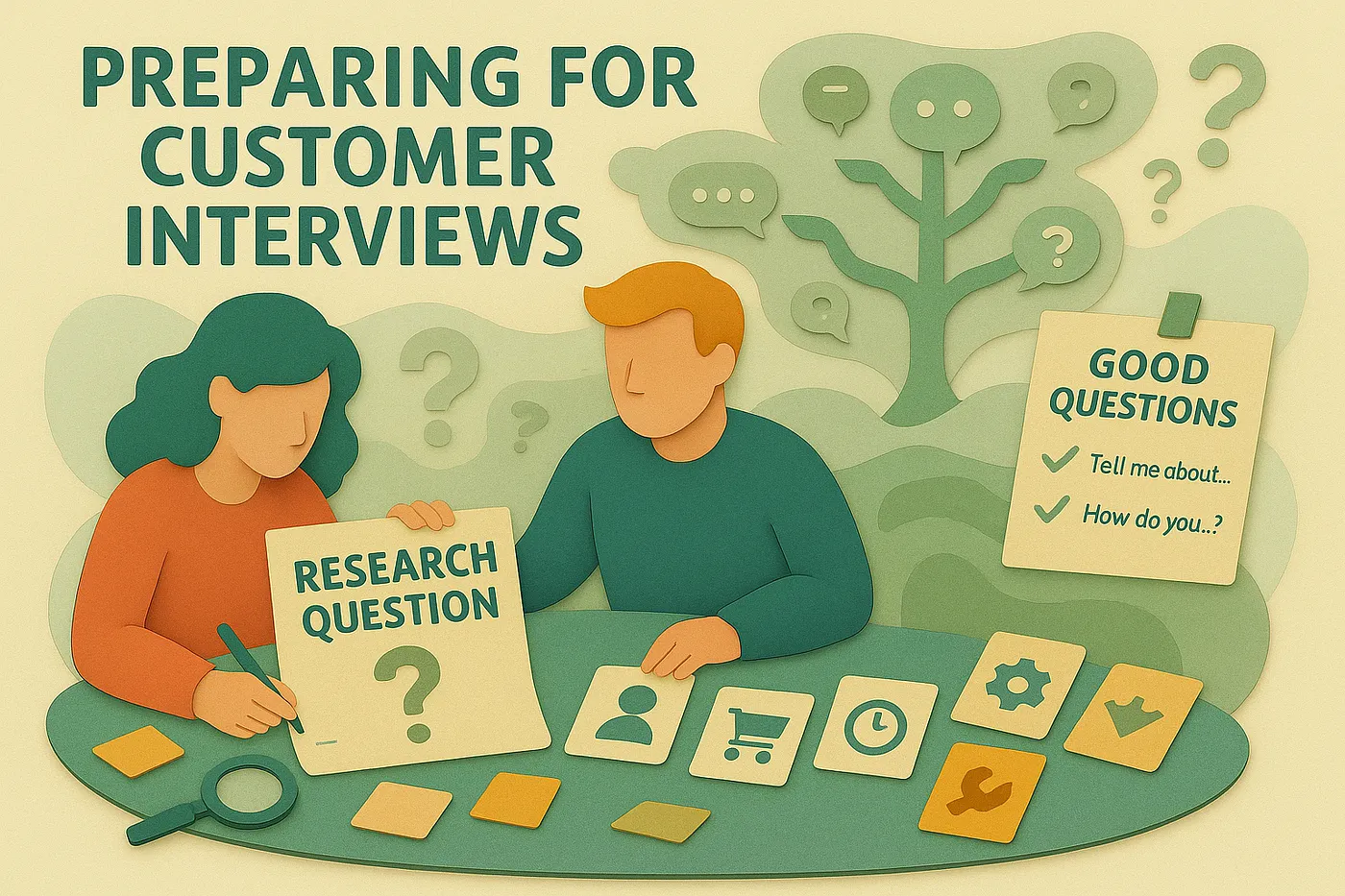
Preparing for customer interviews
How to find the right users, ask the right questions, and get real insights.
Start with the right people.
Good interviews start with the right users. If you don’t talk to people who’ve lived the experience you’re trying to understand, you’ll waste everyone’s time.
Before you schedule anything, get clear on who you need to talk to. Go back to your goal. What are you trying to learn? What outcome are you hoping to influence?
You’re not looking for just anyone. You’re looking for people who’ve done something specific — used a feature, dropped off at a key point, made a decision, or taken an action you care about.
Here are some audience segment examples to get you started:
- Users who clicked on a social ad or organic post
- Users who searched for your product
- Users who landed on a specific page
- Users who have or haven’t used a certain feature
- Users who purchased (or didn’t)
- Users who abandoned a cart
- Users who’ve spent time in your product
Pick the segments that map to your outcome. Don’t just pull a list and hope for the best.
Write a real research question.
Every interview should be anchored by a clear research question. If you skip this, you’ll gather noise instead of insight.
A research question is not the same thing as an interview question. The research question keeps you focused. It tells you what you’re trying to learn. It makes your interviews more efficient, your notes more useful, and your decisions more grounded.
Here are a few examples:
Goal: Increase engagement.
- What drives engagement today?
- What gets in the way?
Goal: Understand user needs.
- What are the user’s core needs in this situation?
- What’s frustrating or incomplete about how they solve it today?
Goal: Find opportunities for new features.
- What jobs are users still doing outside the product?
- What would make them come back more often?
Goal: Improve the user experience.
- Where do people get stuck or confused?
- What makes the experience feel frustrating or slow?
Once you have your research question, use it to guide what you ask — and how you listen.
Ask questions that get real stories.
Good interview questions sound like conversations, not surveys. Your goal isn’t to get opinions. It’s to uncover behavior, context, and emotion.
Avoid leading questions. Avoid assumptions. Ask open-ended prompts that get people talking about what they did, not what they think you want to hear.
🚫 Don’t ask:
- Do you like the product?
- Did the new feature help you?
✅ Ask instead:
- What’s your experience been like with the product?
- Tell me about the last time you used the new feature.
A few more solid go-to questions:
- Tell me about when you first started thinking about ___
- Walk me through what you did next
- What made that frustrating or confusing?
- What were you expecting to happen?
- How do you usually approach ___?
Your goal is to get the full story: what happened, what they did, what they felt, and what they wanted. Then you can spot the real opportunities underneath.
In Conclusion
To run better interviews, do a little prep that actually matters:
- Know who you need to talk to and why
- Write a research question that keeps you focused
- Craft interview questions that prompt real stories, not surface-level opinions
- Avoid leading language or assumptions
- Keep your ears open for needs, pain points, and moments of emotion
The goal isn’t to run perfect interviews. It’s to learn something that moves your product forward.
Learn more about customer interview questions.
- Interviewing Customers
- Product Talk Academy | Continuous Interviewing
- Product Talk Blog | Why You Are Asking the Wrong Customer Interview Questions
- Product Talk Blog | Ask About the Past Rather Than the Future
- How Asking Works: A Crash Course in Customer Discovery Questions