July 21, 2025 | Career, Product Discovery
Roles on the product trio
When roles are unclear, product work gets messy — start here.
Clear roles don’t mean rigid roles. The trio works best when each person leans into their strengths , and covers for each other when needed.
— Kristy Sullivan
Ever wonder who’s responsible for what on a product trio? We did too.
After a lot of trial and error, we’ve clarified which tasks belong to which role, who’s leading what, and how to bring the rest of the squad along without slowing everything down.
Let’s be honest: every team is different. And every trio is made of people with different strengths. That’s the point. This article will show you how we’ve made role clarity work, not with strict rules, but with shared habits and team awareness.
If you’ve ever asked, “Wait, am I supposed to own that?”, you’re in the right place.
What it is
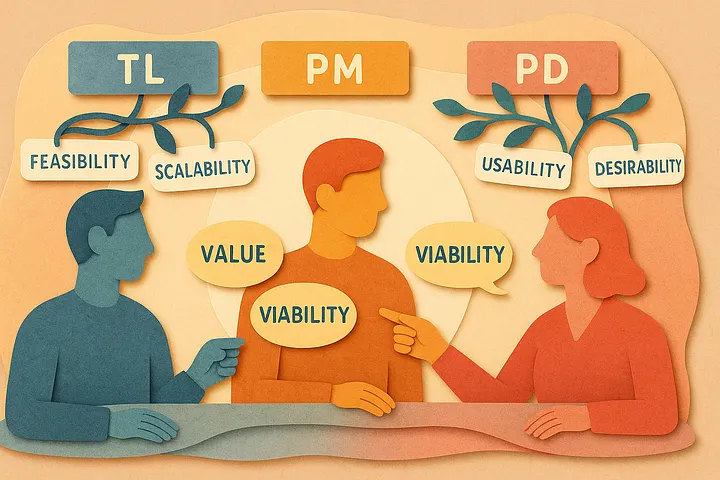
The product trio is the core decision-making unit on a product team. It’s made up of the product manager, product designer, and tech lead. Together, they own both discovery and delivery, not in a handoff, but as an ongoing, collaborative process.
Each role brings a different focus:
- Product Manager (PM) = Value and Viability
- Product Designer (PD) = Usability and Desirability
- Tech Lead (TL) = Feasibility and Scalability
But those aren’t silos. The strongest trios share accountability for outcomes. They make decisions together. And they flex when needed, depending on the problem, the project, or the person.
How other experts think about trio roles.
Where Silicon Valley Product Group (SVPG) and Continuous Discovery Habits (CDH) agree.
- The trio is the core decision-making unit.
- Each person brings a distinct lens, but owns outcomes together.
- Avoid handoffs, and work together from start to finish.
- Discovery is for everyone, not just Product Managers or designers.
Where they differ
Role clarity
- SVPG: Clear domains, defer to the expert
- CDH: Shared decision-making
Conflict resolution
- SVPG: Defer to role ownership
- CDH: Test assumptions
Focus
- SVPG: Strategy, structure, leadership
- CDH: Weekly discovery habits
Time in discovery
- SVPG: Flexible based on delivery
- CDH: Designers lead; engineers stay involved
Primary lens
- SVPG: Org-level transformation
- CDH: Team-level rituals
How to do it
We’ve worked with several product trios across squads, and here’s what we’ve learned: clear expectations make everything easier.
You don’t need a rigid playbook. But you do need to know who’s leading, who’s supporting, and who needs to be looped in. That’s how you keep momentum without stepping on toes.
We also learned the hard way that keeping the rest of the squad in the dark slows everyone down. Sharing outcomes, interview insights, and test results with your full squad builds trust and speeds up delivery.
When everyone’s in the loop, the whole team moves faster and stays healthier.
Outcomes
- The Product Manager (PM) sets the outcome with input from the trio.
- Product Designer (PD) and Tech Lead (TL) are consulted.
- The trio is responsible for hitting it.
- Squad stays informed and aligned on progress.
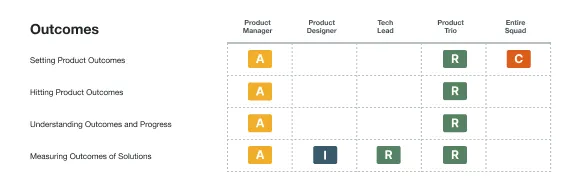
Roles of a Product Trio for Outcomes
Knowing the customer
- Trio leads interviews and feedback synthesis.
- Product Manager (PM) brings context from research and business needs.
- Tech Lead (TL) contributes where it supports discovery.
- Trio reviews insights together.
- Squad is looped in to maintain alignment.
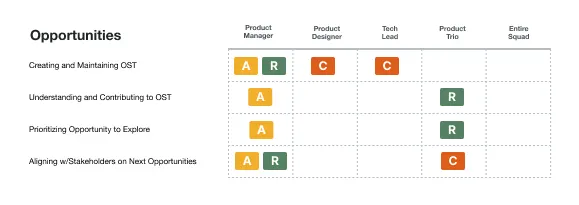
Roles of a Product Trio for Opportunities
Opportunities
- Product Manager (PM) keeps the OST up to date.
- Product Designer (PD) and Tech Lead (TL) contribute insights and patterns.
- Trio prioritizes opportunities to explore.
- Squad contributes where needed and reviews what’s next.
Roles of a Product Trio for Opportunities
Discovering solutions
- Product Designer (PD) leads ideation and prototyping.
- Tech Lead (TL) ensures feasibility.
- Product Manager (PM) focuses on value and business impact.
- Trio makes decisions together.
- Squad contributes during ideation and testing.
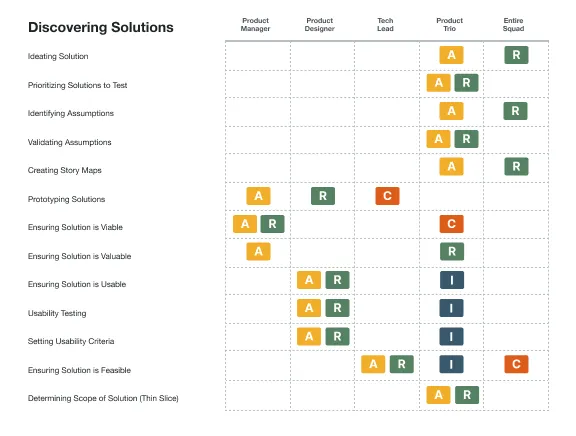
Roles of a Product Trio for Discovering Solutions
Fun Examples
The designer was out, so the PM sketched it.
The PM had a design background and wasn’t afraid to open Figma. They kept the sketch rough and invited fast feedback so the team could keep moving.
The Tech Lead owned the analytics.
The TL loved data and built a lightweight dashboard before anyone even asked. The trio made smarter calls with real-time metrics in hand.
The Designer shared what’s next.
The PM was out, but the PD had full context and shared the trio’s priorities with stakeholders in a quick async Loom.
Conclusion
Strong product trios aren’t about drawing lines in the sand. They’re about knowing your lane and when to step out of it.
When each person leans into their strengths, keeps the squad informed, and makes space for each other, the whole team works better. It’s not about perfect clarity. It’s about shared commitment to the outcome and each other.
Take Action
Want to strengthen your trio and bring more clarity to your roles? Start here.
1. Review your current trio dynamic
- Who leads what today?
- Where are the overlaps or gaps?
2. Use the RACI as a conversation starter
- Talk through each area
- Clarify who’s leading, contributing, and supporting
3. Keep the squad informed
- Share outcomes and discovery regularly
- Make context part of your working rhythm
4. Revisit quarterly
- As teams shift or goals change, realign
- Make it a habit, not a one-time agreement