January 14, 2023 | Career, Product Discovery
User research for product teams
Three steps to understanding what your users actually need.
User research exists to close the gap between what a product team thinks users need and what users actually need. It informs decisions about what to build, how it should work, and whether an idea is worth pursuing in the first place.
Done well, it surfaces things the team would have missed. Done poorly, it gives people permission to build the wrong thing with confidence.
Here’s how to do it well.
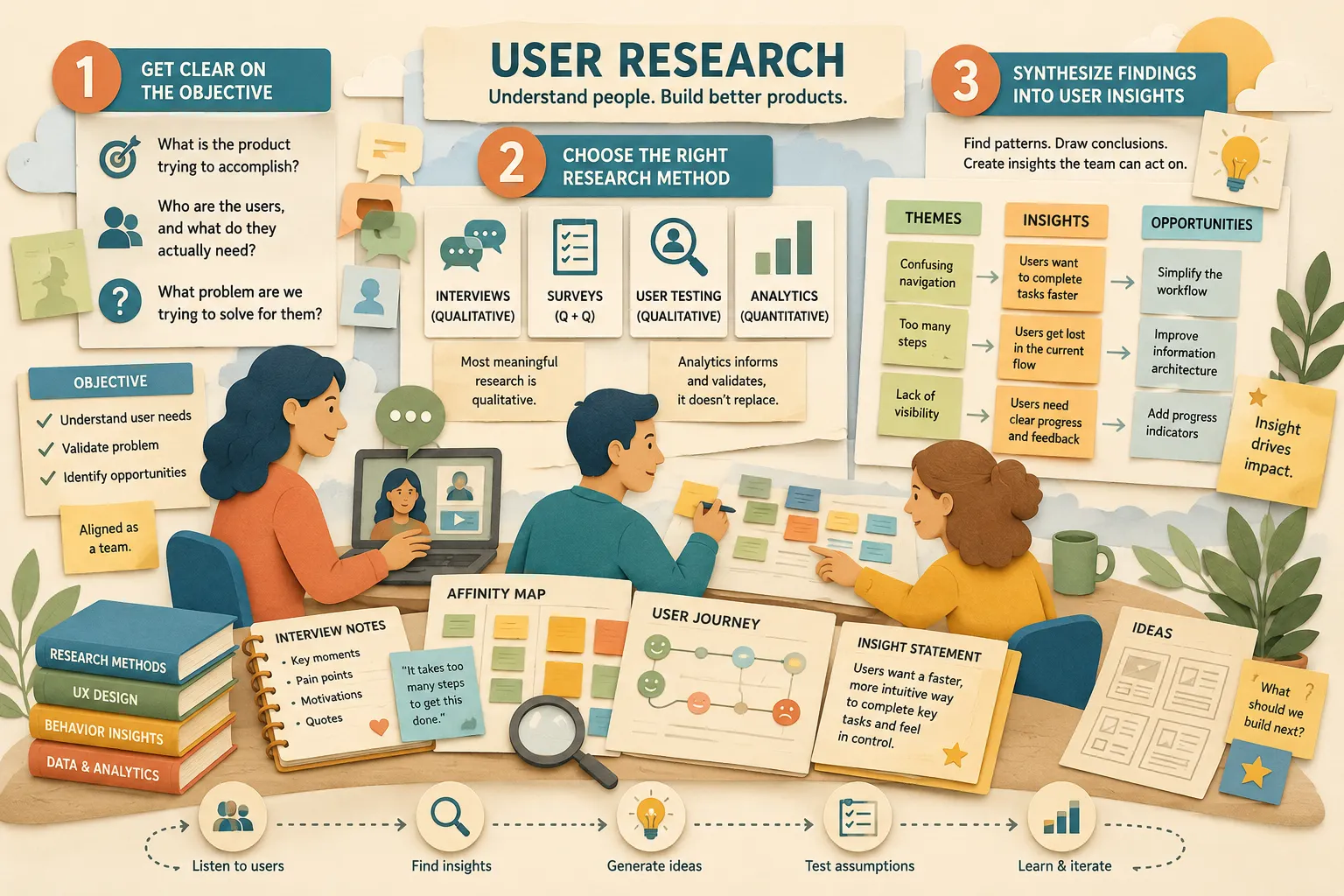
Step 1: Get clear on the objective.
Before choosing a method or talking to a single user, the team needs to agree on what they’re trying to learn. That sounds obvious. It’s frequently skipped.
Start with these questions:
- What is the product trying to accomplish?
- Who are the users, and what do they actually need?
- What problem are we trying to solve for them?
The answers shape everything downstream: who you research with, what method you use, and how you interpret what you hear. If the team can’t agree on the objective, the research won’t resolve it for them.
Step 2: Choose the right research method.
There’s no universal best method. The right one depends on what you’re trying to learn. Before picking one, it helps to understand the two categories you’re working within.
Qualitative research explores how users think, feel, and behave. It asks open questions and observes. It produces insights that are rich but require interpretation.
Quantitative research measures behavior at scale. It produces data that’s easier to aggregate but doesn’t explain the “why” behind what users do.
Most product research leans qualitative. Analytics rounds it out. Here’s a practical breakdown of the most common methods:
User interviews (qualitative) The most direct way to understand what users need and why. They allow for follow-up, surface unexpected problems, and build real relationships with your users. They’re also time-intensive and harder to scale. Worth it when you need depth.
Surveys (qualitative and quantitative) Fast, affordable, and easy to distribute. Useful for gathering directional data across a larger group. The tradeoff is that survey questions constrain the answers — you can only learn what you thought to ask about. Bias in question design is a real risk.
User testing (qualitative) Watching users interact with your product in real time is irreplaceable. It shows you behavior that users themselves can’t always articulate. It takes more resources to set up and analyze, and small sample sizes can limit reliability. Still one of the most valuable methods available.
Analytics (quantitative) Analytics tells you what users are doing at scale. It can validate or challenge qualitative findings. What it can’t tell you is why users are doing it. Use it to round out your picture, not to replace direct research.
A note worth keeping in mind: most meaningful user research is qualitative. Analytics should inform your interpretation, not drive it.
Step 3: Synthesize findings into user insights.
Data from user research doesn’t speak for itself. Someone has to make sense of it.
First, decide where the data lives. The whole team needs access to it. Tools like FigJam, Notion, OneNote, or even a shared spreadsheet work fine. What matters is that everyone knows where to look and can actually get there.
Then work through the synthesis:
- Look for patterns, recurring themes, and trends across the data.
- Group related findings into categories.
- Draw conclusions about what users need and what’s motivating their behavior.
- Translate those conclusions into actionable insights the team can build from.
The output isn’t a report. It’s a clear understanding of user needs that can drive a product decision.
In Conclusion
User research is how product teams stop guessing. Start with a clear objective, pick a method that fits the question, and synthesize what you learn into something the team can act on.
From there, the next step is generating ideas against those insights, forming hypotheses, and testing them. The research doesn’t end when the interviews do — it feeds the whole cycle.